- 0xResearch
- Posts
- Who priced it first?


Hi, everyone.
Markets opened the week with geopolitics back in focus. Strikes on Iran sent gold, silver and crude sharply higher, reviving inflation risks and adding fresh uncertainty to an already fragile tape.
Crypto saw selective strength in equities and ETF flows, but the more interesting story played out over the weekend, during which onchain venues stepped in while COMEX slept. We unpack the implications below.

Over the last week, gold is up 2.11% while the S&P 500, Nasdaq and BTC are down −0.07%, −0.45%, and −3.51% respectively.

The big headline came over the weekend as Israel and the United States launched joint strikes on multiple sites in Iran, escalating tensions in the Middle East. Safe-haven assets reacted immediately. Since Friday’s market close, gold and silver are up 2.3% and 13.1% respectively. Crude oil futures have surged over 8.5% amid concerns around supply disruptions, with major traders suspending shipments through the Strait of Hormuz.
Higher oil prices bring inflation risks back into focus. Last week’s PPI already surprised to the upside, rising 0.5% versus the 0.3% consensus for January. The path forward now hinges on the scale of Iran’s response and whether the conflict broadens, both of which could inject further volatility into global markets.
In crypto, equities were the standout performers, up 6.6% on the week. The move was largely driven by CRCL, which rallied 35.7% after strong Q4 earnings prompted multiple Wall Street upgrades.
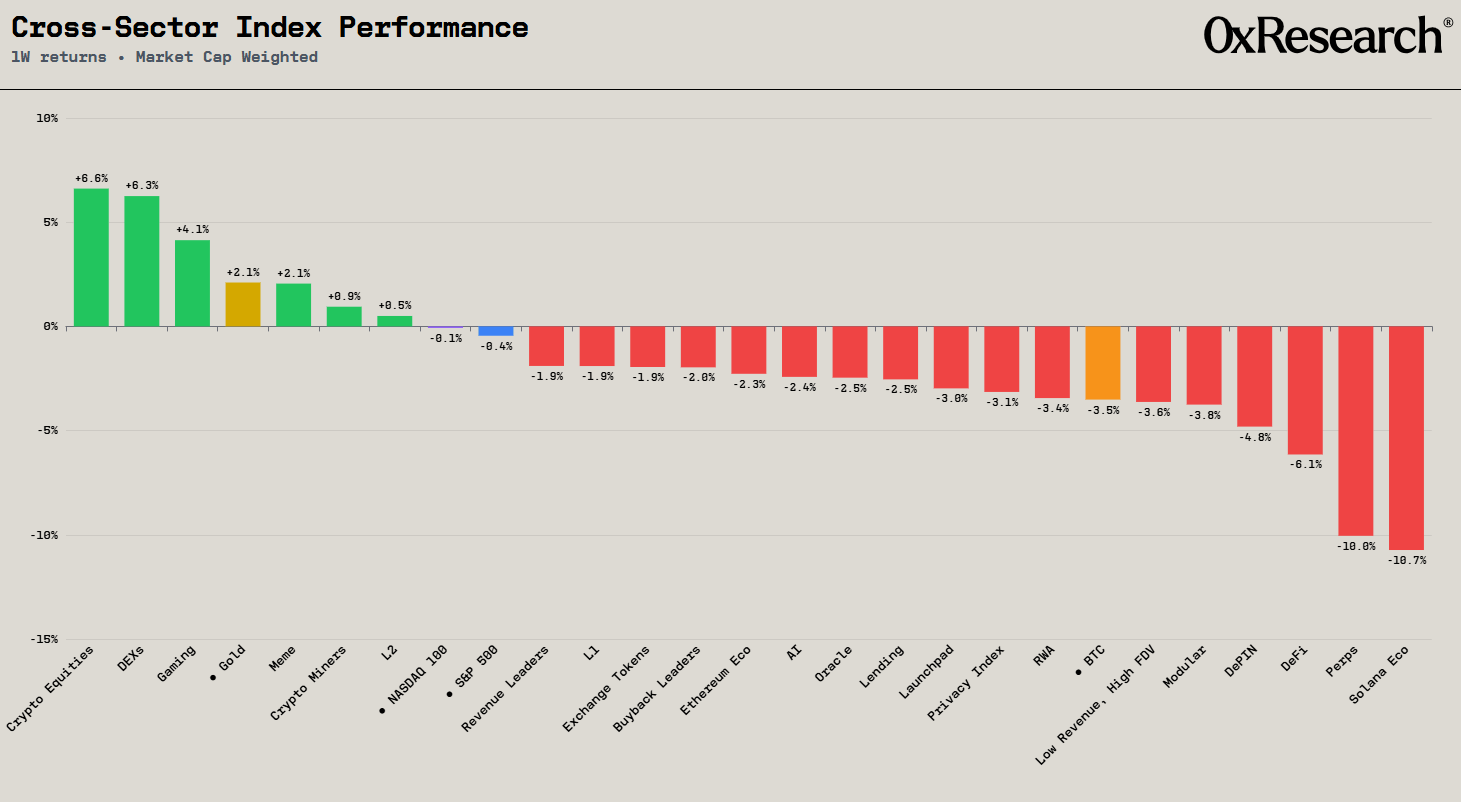
Circle reported Q4 revenue of $770 million, up 77% YoY, supported by accelerating USDC adoption. USDC in circulation reached $75 billion, up 72% YoY, while onchain volumes hit $12 trillion, up 247% YoY. With Arc Mainnet slated for 2026 and continued traction in the Circle Payments Network, institutional momentum remains strong.
On the ETF front, flows turned decisively positive. BTC, ETH and SOL ETFs collectively saw $912.4 million of inflows last week, breaking a five-week streak of outflows that totaled $5.1 billion.

After weeks of persistent selling, fresh ETF demand is a meaningful shift and one worth watching closely if geopolitical uncertainty continues to rise.
— Kunal
When COMEX sleeps
This weekend’s geopolitical escalation once again highlighted the importance of venues like Hyperliquid and Binance, where traders can express risk views while traditional markets remain closed. To understand how effective these venues were, we looked at gold and silver price action on Trade.xyz and Binance’s XAU and XAG perpetual markets relative to COMEX.

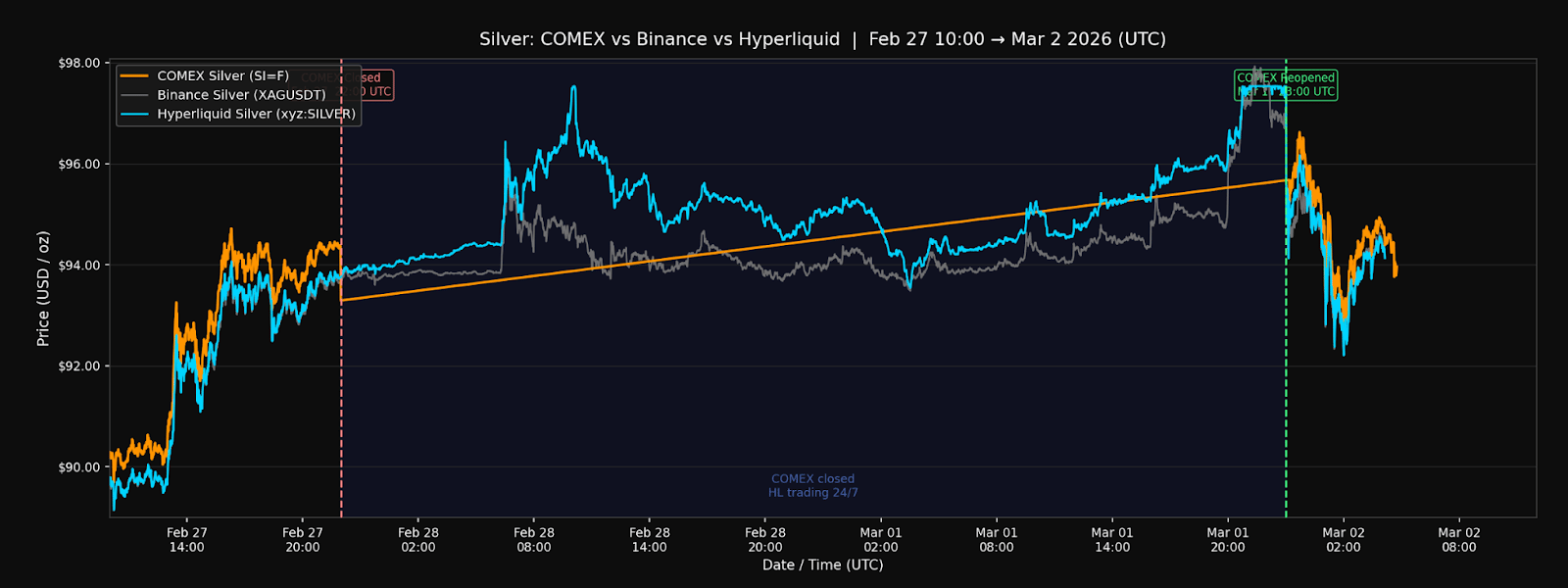
Under normal conditions, both Hyperliquid and Binance perps trade at a slight discount to COMEX. This is structural: COMEX prices reflect front-month futures with the cost of carry embedded, while perps track closer to spot. Against that backdrop, the weekend divergence becomes more telling.
After COMEX closed on Friday, prices on both venues began drifting higher. Hyperliquid moved more aggressively and sustained a materially higher premium throughout the weekend. When news of the strikes on Iran broke, both exchanges reacted sharply, but Hyperliquid consistently priced metals higher than Binance.
Across the weekend, gold and silver traded at median premiums of 75bps and 78bps on Hyperliquid relative to Binance. During regular weekday hours, that premium is typically near zero. The divergence suggests traders on Hyperliquid were pricing in significantly more geopolitical risk than those on Binance.
When COMEX reopened, gold and silver prices on Hyperliquid were closer to COMEX by 22bps and 31bps, respectively, compared to Binance. In other words, Hyperliquid’s weekend pricing proved to be the more accurate predictor of where traditional markets would reopen.
Yet in raw dollar terms, Binance dominates volume. Its share versus Trade.xyz has climbed from 54% at the lows to 93% today for gold markets.

A similar pattern is visible in silver, where Binance’s share has risen from 23% to 77%.

However, open interest tells a different story. OI across both platforms is nearly identical for both metals. That means Hyperliquid is generating comparable OI with materially different volume dynamics.

Daily volume relative to OI is 12.6 times higher on Binance for gold and 2.8 times higher for silver. That magnitude of difference raises legitimate questions about the nature of the volume.

The takeaway is clear. While Binance leads in raw volume, Hyperliquid is showing stronger signs of organic participation and cleaner price discovery. With comparable open interest and closer alignment to COMEX reopen levels, Hyperliquid is increasingly proving to be the venue where real risk gets priced first.
— Kunal


This report argues that yield compression in crypto is broad-based, not isolated to one product.
As risk appetite has faded, funding rates in perpetual futures have collapsed, squeezing the profitability of the delta-neutral basis trade that underpins many stablecoin yields. Weekly returns that once offered double-digit annualized carry have fallen toward zero, making the trade far less attractive. Yield-bearing stablecoins have all seen lower APRs in the same period, with declines that move largely in tandem.
Data does not show one product deteriorating in a statistically distinct way. The core driver is simple: Weaker demand for leverage and risk is pulling yields down across the entire market.

Galaxy argues that the real question is not whether AI needs crypto, but what kind of economic infrastructure autonomous agents will require.
Recent waves of onchain AI experimentation show that crypto already functions as a capital-formation and settlement layer for agent-driven systems. While early agent tokens were largely speculative, newer iterations demonstrate that blockchains provide permissionless funding, programmable payments, and global coordination that traditional rails cannot match. Stablecoins, emerging payment standards, and identity frameworks are laying the groundwork for agents to transact and operate autonomously.
Though current models still rely on speculation and weak token design, the broader signal is clear: Crypto is positioning itself as the most viable economic substrate for an emerging agentic economy.

Stani Kulechov argues that DeFi has largely solved the supply side of capital by attracting deep onchain liquidity, but the next phase is unlocking real-world demand, especially in infrastructure. He sees a 100 to 200T opportunity in financing assets like solar, data centers, robotics, EV networks and space infrastructure, all of which require heavy upfront capital and generate long-term cash flows.
Aave could serve as the base financial layer by lending against tokenized infrastructure or supporting yield-bearing stablecoin structures tied to these assets. Rather than focusing only on traditional RWAs, he positions Aave as the core liquidity engine funding the physical systems that power a future abundance economy.

DAS NYC's lineup is bringing the biggest names in finance to the stage.
Don't miss the institutional gathering of the year — this March 24−26.