- 0xResearch
- Posts
- “Trust Me Bro” Bridges
“Trust Me Bro” Bridges

Luke Leasure
April 30, 2026

Hi all, happy Thursday!
Equity markets are hitting new highs after the FOMC held rates steady and mega caps beat on earnings, while crypto showed a mid-week stumble. Onchain lending remains pressured by Aave's lingering Kelp exploit fallout, though stablecoin markets are showing early signs of recovery.
Speaking of Kelp, bridges in general have always been a weak link. We look at why more robust solutions haven’t prevailed in the market to date and what might come next.
Equity markets remain strong off the back of Jerome Powell’s last FOMC and earnings releases from GOOGL, AMZN, META, and MSFT, with the Nasdaq making new all-time highs after hours into Thursday’s session. The FOMC voted 8-4 to hold rates constant at 3.5%-3.75%, and all the aforementioned mega caps beat expectations on both revenue and earnings. Despite strength in equities, crypto shows a wobble on the daily timeframe, as BTC and the majority of crypto indices drew down on the day, with the notable exception of crypto-related equities.

The lending sector's underperformance continues to tie directly to the hangover of Aave’s exposure to the Kelp exploit. WETH utilization remains pinned at 100%, with the market refusing to clear nearly two weeks after the exploit and the subsequent market freeze. Until the WETH market normalizes, one of the largest collateral pools in onchain credit will remain a drag on the sector.

The stablecoin side is finally showing signs of relief. USDC utilization, which spent four straight days pinned near 100%, has eased back into the low 90s alongside DAI and USDT. Borrow rates are still elevated relative to pre-exploit levels, but net deposit flows on USDC flipped positive +$32M over the past day, with supply coming in to harvest the elevated rate and letting the market clear. With Aave's USDC market back to liquid, this is the first sign that credit here may be finding its footing.
— Luke
The neglected bridge
When roughly $290 million was siphoned out of the LayerZero-powered bridge KelpDAO uses for rsETH 12 days ago, the crypto industry did what it always does after a nine-figure cross-chain loss: it argued about whose fault it was. RPC poisoning? DVN misconfiguration? The acronym-ridden forensic answer obscures the historical one.
Bridges, as a category, are fragile. They also don’t really “move” anything. Rather, they produce a sentence — "X happened on chain A" — and ask a second chain to treat it as true. Every drained bridge was drained because the destination chain said "yes" to a sentence it shouldn't have.
Reading back through Blockworks' coverage tagged bridges is like reliving the same accident. Nomad ($190M, August 2022). Multichain ($130M, July 2023). Heco ($87M, that November). Orbit ($80M, January 2024). Socket two weeks after that. By late 2023, Chainlink's Sergey Nazarov was telling Blockworks that most bridges are "absolutely not secure"; Uniswap's own bridge committee was franker still: Crypto Bridges Tend To Collapse.
The scorecard for one cross-chain protocol reads differently, however: Interblockchain Communication (IBC). Aside from a single close call with a critical vulnerability in April 2024 — a bug patched before it could be exploited — IBC has just worked.
Why? Because it was never the same kind of beast. Validator bridges and DVN networks are external attestors: the destination chain accepts someone else's word. IBC is a light-client protocol, meaning each chain verifies the other's consensus onchain, block by block. The verification itself is what's under scrutiny, not a committee of offchain signers.
The Ethereum rollup world could have imported this primitive. A middle ground was the Gnosis-funded Hashi Alliance, which tried stacking multiple independent verifiers so no single oracle, multisig, or relayer can forge a message through. But obstacles to adoption, such as latency capped by the slowest verifier, and gas paid across all of them, ended up stymying the project.
Gnosis’ preferred fix, the Ethereum Economic Zone, aims at synchronous cross-chain execution that makes bridging far less relevant in the first place.
The LayerZero/KelpDAO incident is a reminder that a bridge's real security is whatever the weakest path through its verifier set happens to be on a given Saturday morning. The only nearly flawless record in production, for now, belongs to the one bridge protocol that never called itself one.
— Macauley


This article by Arrakis argues that Trade.xyz’s activity has a large sybil/airdrop-farming layer, including 35,091 farmer wallets, but those wallets produced less than 1% of total volume. Using deterministic Hyperliquid order metadata, the authors find that actual volume is dominated by a tiny set of market makers: 363 wallets, or 0.46% of active addresses, drove 63% of the $51.95B traded during the March 10–31, 2026 window. The identifiable real trading base includes major desks like Jump Crypto, Selini Capital, and Wintermute, plus a surprisingly large Polymarket-linked cohort, so the conclusion is that Trade.xyz’s wallet count is inflated pre-TGE, but its dollar volume appears to come from real market makers, bots, and directional traders rather than high-volume wash trading.

On this episode of Invest Like The Best, Paul Tudor Jones frames great trading as relentless risk management, patience, and execution: unlike long-term investors such as Warren Buffett, whom he now admires as “the OG of compound interest,” traders live in the trenches looking for rare market dislocations and catalytic moments. On Bitcoin, he says the 2020 setup was a “knockout” trade and calls Bitcoin “unequivocally the best inflation hedge” because it is finite in supply and decentralized, while also warning that its electronic nature creates risks in cyberwarfare or quantum-computing scenarios.
Aerodrome Finance is the dominant DEX on Base. Launched in August 2023 by Dromos Labs, the protocol was designed from inception to serve as Base's primary liquidity layer. Its product suite spans a constant-product AMM for stable and volatile asset pairs, and Slipstream, a concentrated liquidity module closely derived from Uniswap V3 that allows LPs to deploy capital within defined price ranges for improved capital efficiency.
Aerodrome holds ~$240M in TVL, with cumulative fees since launch exceeding $322M.
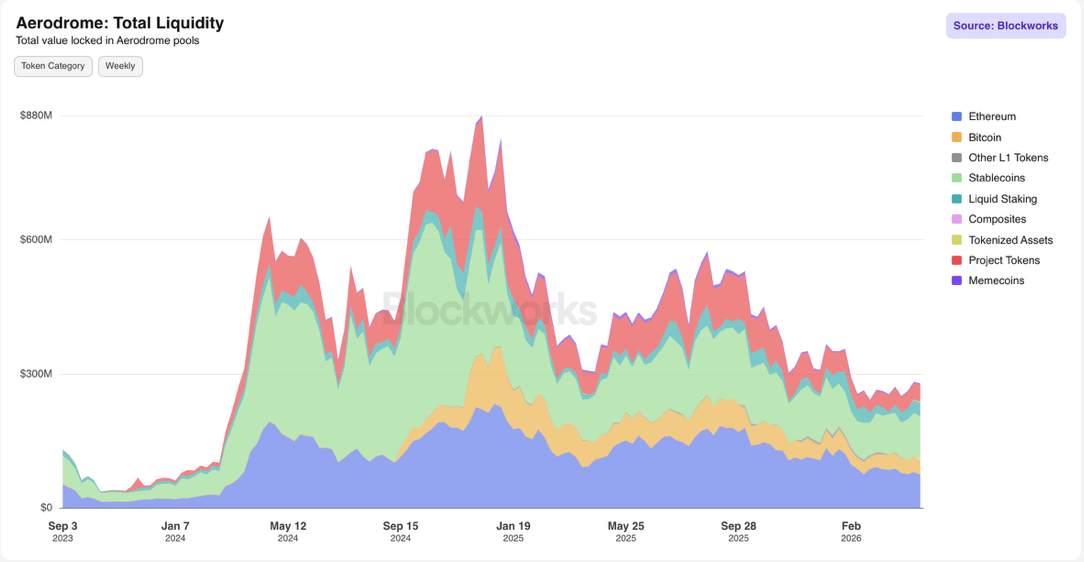
The protocol is preparing a major architectural upgrade, Aero/MetaDEX03, targeting a Q2 2026 launch that will merge Aerodrome and Velodrome into a unified cross-chain DEX and introduce MEV internalization as a new revenue stream.