- 0xResearch
- Posts
- The House Always Wins


Gm, and happy Thursday! It’s another great week to be a bull as equities trade new all-time highs and BTC makes new range highs. While the privacy sector leads, crypto miners stand out from the converging tailwinds across AI, equities, and crypto, with most names reporting earnings this week and trading strong off the releases. More on the convergence of AI and crypto, check out this Bittensor subnet building a higher-accuracy, lower-cost alternative to Zillow’s Zestimate product. Enjoy!

The bulls firmly control the trend in risk assets, with the S&P 500 and the Nasdaq each closing Wednesday at a new all-time high. For the Nasdaq, every session over the past 5 sessions has traded a new all-time high. For crypto, BTC has traded to new range highs over the past 3 sessions, marking the highest prices since the February selloff. Over the past week, the privacy index leads the board, up 27.6% as a sector on the back of ZEC and DASH’s 54% and 44% moves, respectively.
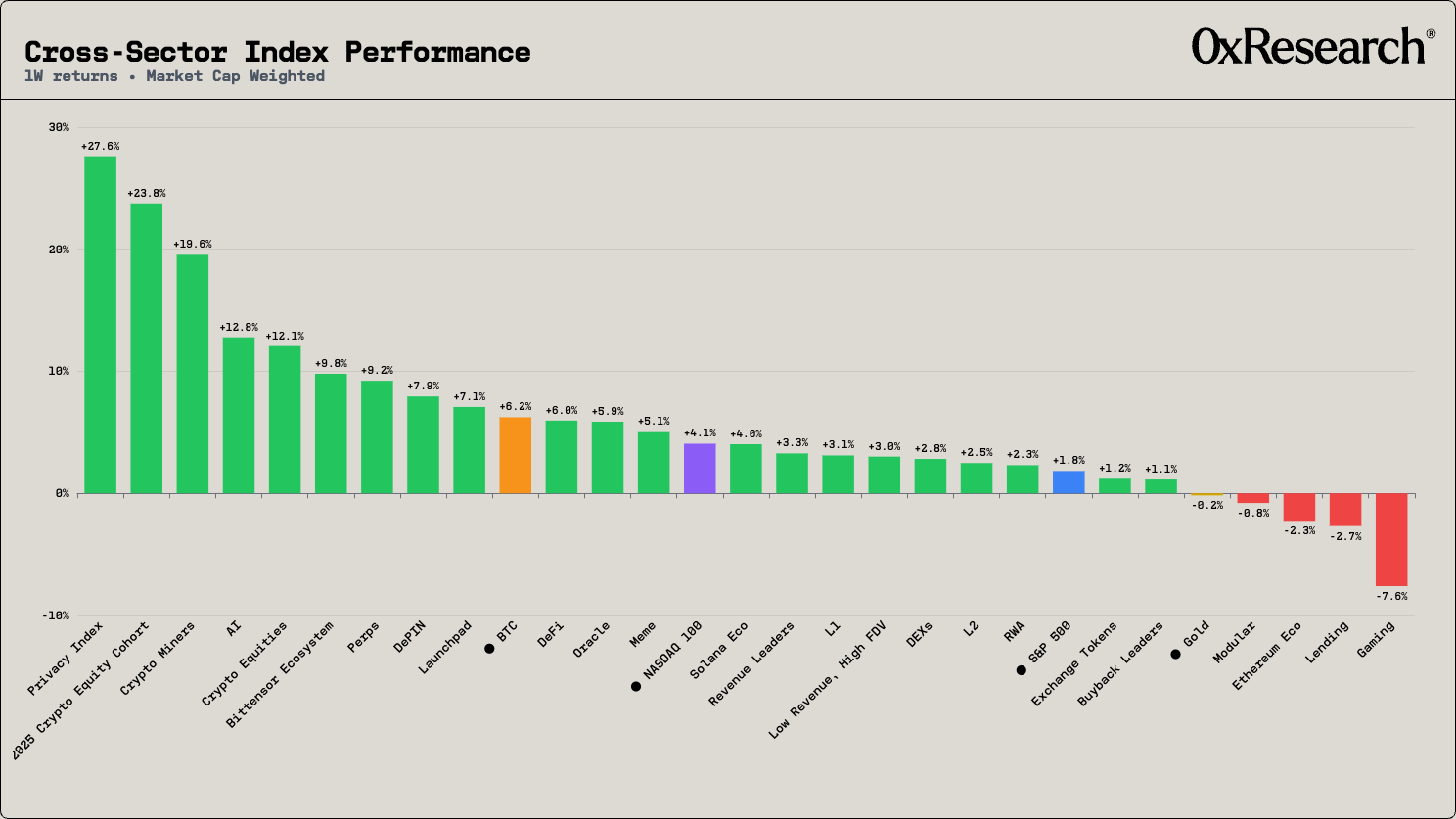
Benefiting from the combined strength across both BTC and equities, crypto miners are near the top of the leaderboard as well. One such standout is HUT, up 35% on the day on the back of its earnings release, despite missing expectations on both revenue and earnings. Behind this move is Hut 8 signing a new 15-year lease at a $9.8B contract value, tripling their contracted capacity. CIFR, RIOT, HIVE, and IREN have all traded up over 20% this week as well.
— Luke
DeFi Comes for the Zestimate
The 30-year fixed mortgage rate sits at 6.51% today; the Fed has held rates for a third consecutive meeting in 2026, and the US housing market remains effectively frozen for the median buyer. Meanwhile, 65% of US households cannot afford a median-priced new home, and prices have jumped 27-80% depending on the market over the past five years.
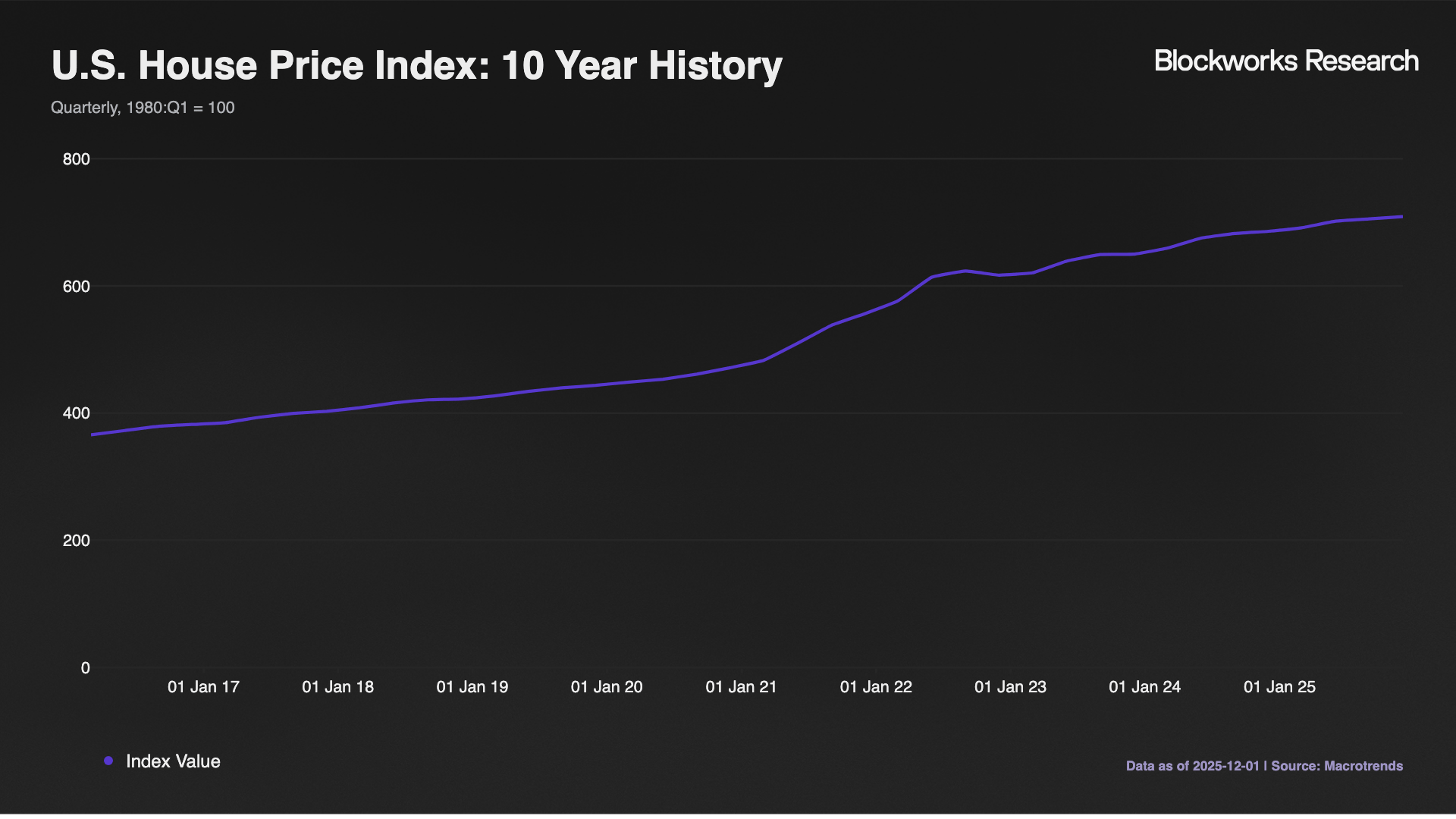
The US has no unified real estate database, making the process of determining fair property valuations increasingly difficult. Zillow spent millions building Zestimate, aggregating 500-600 fragmented MLS systems to produce an estimate that lenders often can’t rely on. Wholesale lenders often compensate by paying for access to five to ten automated valuation APIs simultaneously and averaging the outputs. That opacity is Zillow's moat.
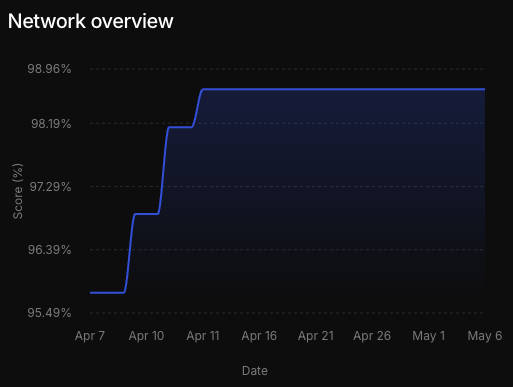
RESI Labs (Bittensor SN46) is building against this directly. The subnet hosts daily onchain competitions where participants submit custom AI appraisal models to Hugging Face, validators rank them by accuracy against real sale prices, and the winning model feeds the product. The current top performer hits 98.7% accuracy across a 200-property test set, sub-second and sub-penny per query. Sebi Ruino, the founder, estimates the build cost at ~$245K, compared to the ~$25M Zillow spent developing Zestimate.
The go-to-market targets wholesale lenders with tens of thousands of downstream originators, offering a drop-in replacement for the valuation waterfalls they already pay for. Resi Finance, the in-development protocol layer, extends this into automated onchain origination for underwriting, Chainlink-fed property oracles, and tokenized loan pools.
Accurate, instant, and open property valuation changes the math across the entire real estate stack. Homeowners get a credible second opinion on what their property is worth without paying for an appraisal. Buyers can underwrite offers faster and with more confidence in thin or opaque markets. Lenders cut origination costs and reduce the manual back-and-forth that stretches closings into weeks. And as Resi Finance matures, the same intelligence layer that prices a home could automate the loan against it, collapsing a process that currently involves a dozen intermediaries into a single onchain workflow. Real estate is a $600T asset class that still prices itself using methods built for the fax machine era.
RESI is also one of the clearest demonstrations of what Bittensor's incentive mechanism can actually do when applied to a problem with real commercial demand. Most subnets compete on benchmarks with no direct revenue path. RESI runs a daily competition where the accuracy improvements compound directly into a product that lenders pay for, creating a closed loop between emissions, model quality, and token buybacks. The Bittensor network functions as RESI's R&D department, one that self-funds, self-improves, and does not appear on the payroll. At a $10M market cap, the market has not yet priced what that compounding looks like at scale.
— Nick


Sasha Kaletsky published a blog post arguing that consumer AI has a fundamental monetization ceiling that enterprise AI does not. The core thesis is that B2B AI captures value from existing spend, letting companies like Anthropic charge more as usage grows, while consumer AI creates value users refuse to pay for beyond a flat subscription. ChatGPT's gross retention looks exceptional, but net revenue per user has stalled, pushing OpenAI toward ads. Kaletsky concludes that standalone consumer AI platforms cannot reach $1T+ valuations without a monetization model that does not yet exist.

Warren Pies argues that markets are being driven by two competing forces: a potentially severe oil shock from the Strait of Hormuz closure and a much stronger bullish force from AI-driven compute demand, model progress, and hyperscaler capex. He says the earnings boom is lopsided toward semiconductors, memory, and energy but still legitimate and broad enough under the surface to support a bullish equity outlook. His preferred framing is overweight stocks and oil commodities and underweight bonds because AI may define markets for the next decade while oil remains the biggest near-term risk.
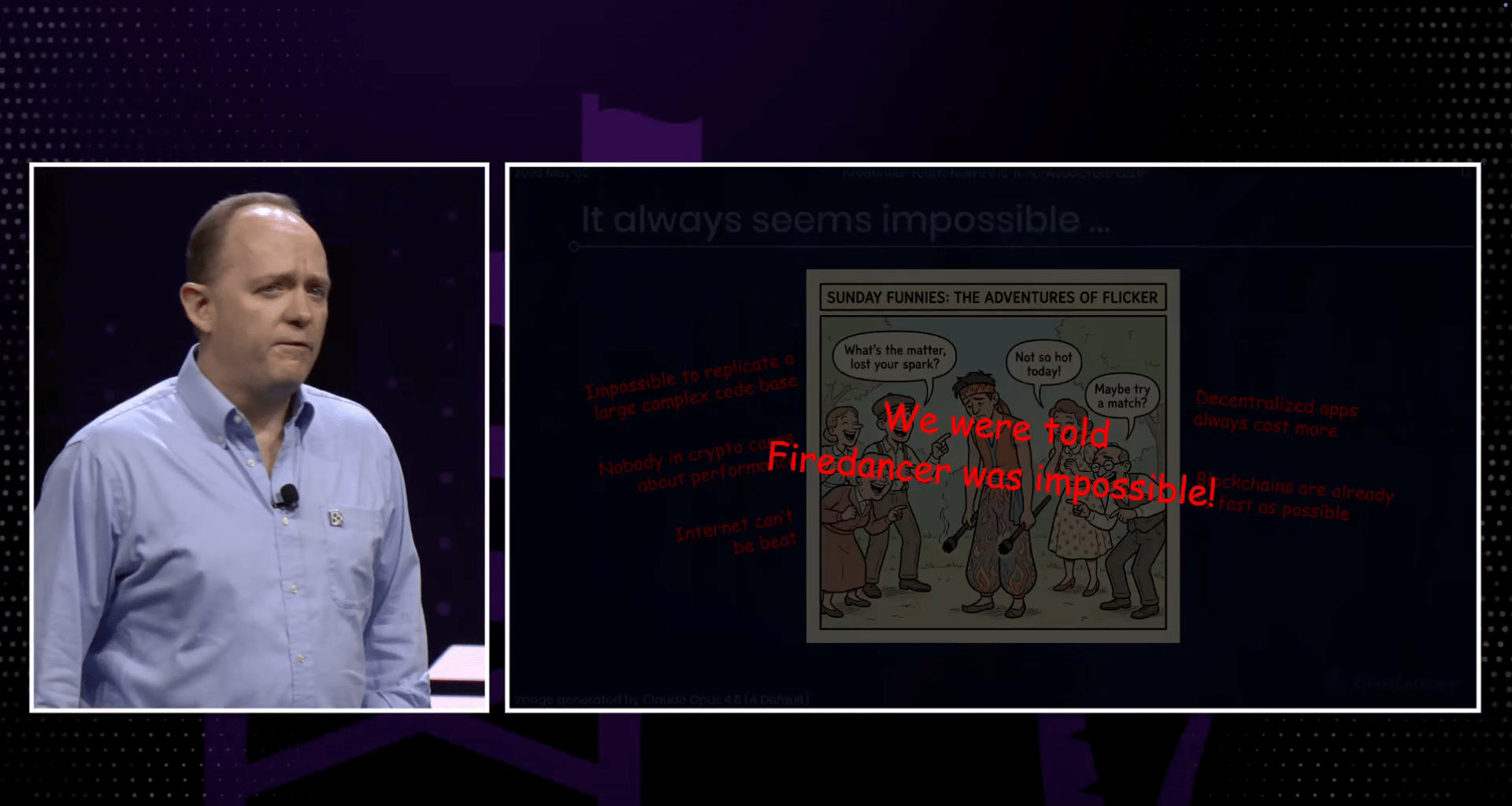
Jump and Solana announced the full rollout of Firedancer 1.0 following a multi-year development effort. The team open-sourced accelerated cryptographic networking and hardware primitives, demoed 1M transfers per second across 100+ intercontinentally distributed validators, and deployed a hybrid validator before shipping the full client. Mainnet stake running Firedancer has reached ~2.5% since Breakpoint 25, with third-party builders now building on top of it. A security audit began on March 3, and a 1.0 branch was cut on April 8 for an audit competition. The client is live and viewable at gui.firedancer.io.