- 0xResearch
- Posts
- Tether's Drift Bailout
Tether's Drift Bailout
Turning crisis into strategic distribution


Sam Schubert & Shaunda Devens
April 17, 2026
GM, and happy Friday!
Traditional markets are stabilizing to close out the week, while crypto-native risk assets caught a massive bid. We're seeing an aggressive rotation into high-beta narratives, with the Meme and Modular sectors dominating the tape.
TIA is doing the heavy lifting for the modular cohort, surging on the back of Celestia's accelerated engineering roadmap and the upcoming mainnet rollout of its V8 upgrade. In today's edition, we also unpack the aftermath of the $295M Drift exploit. We detail how Tether is stepping in with a massive recovery package and turning a crisis into a strategic distribution play to expand USDT's dominance over USDC on Solana.

Following recent macro volatility, traditional markets stabilized over the past 24 hours while crypto-native risk assets caught a massive bid. BTC posted modest gains of +0.8%, edging out the NASDAQ 100 (+0.2%) and S&P 500 (+0.1%). Meanwhile, gold ended the session in the red, down -0.6%, suggesting that the panic-driven flight to safety from earlier in the month continues to cool off.
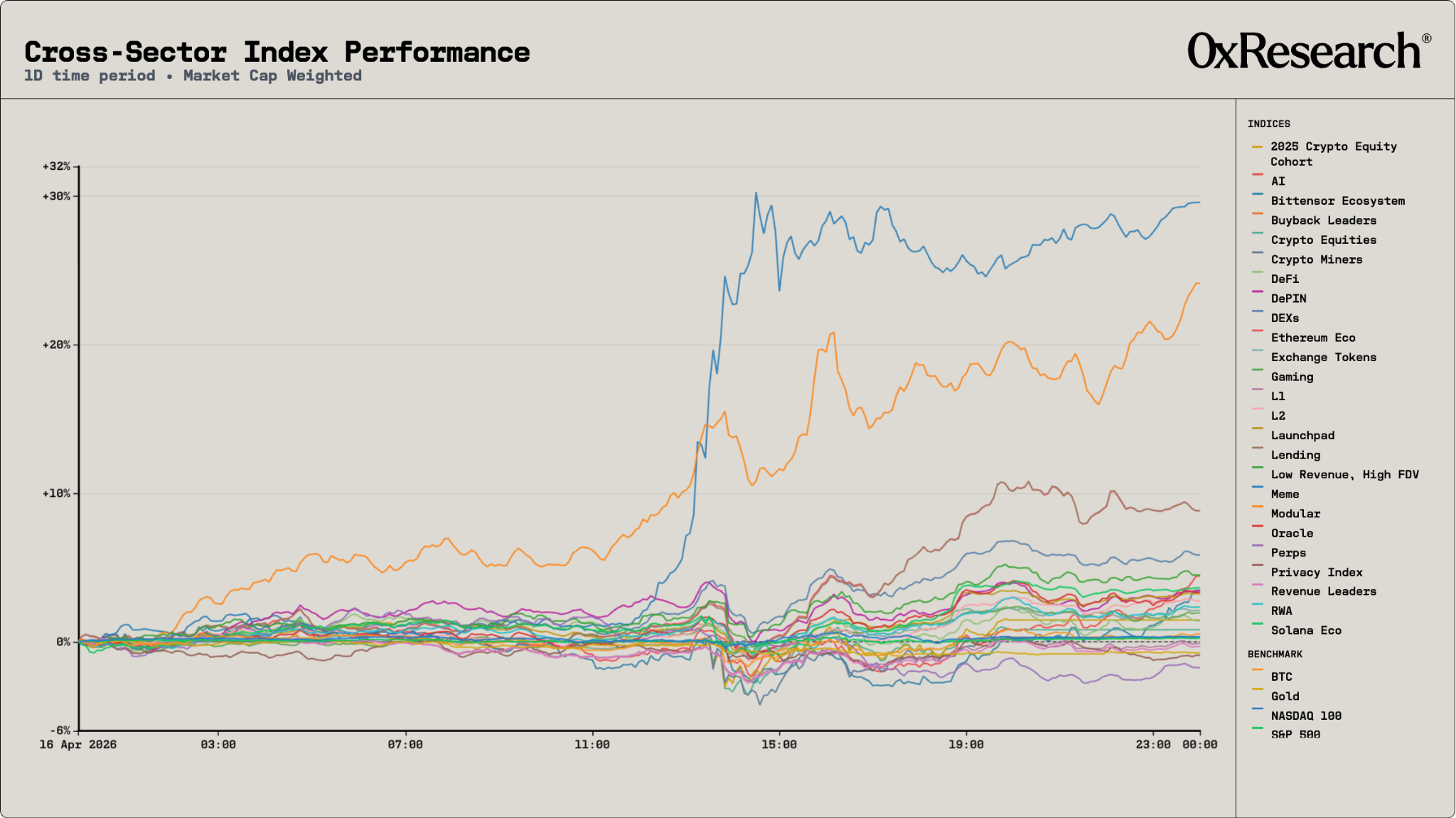
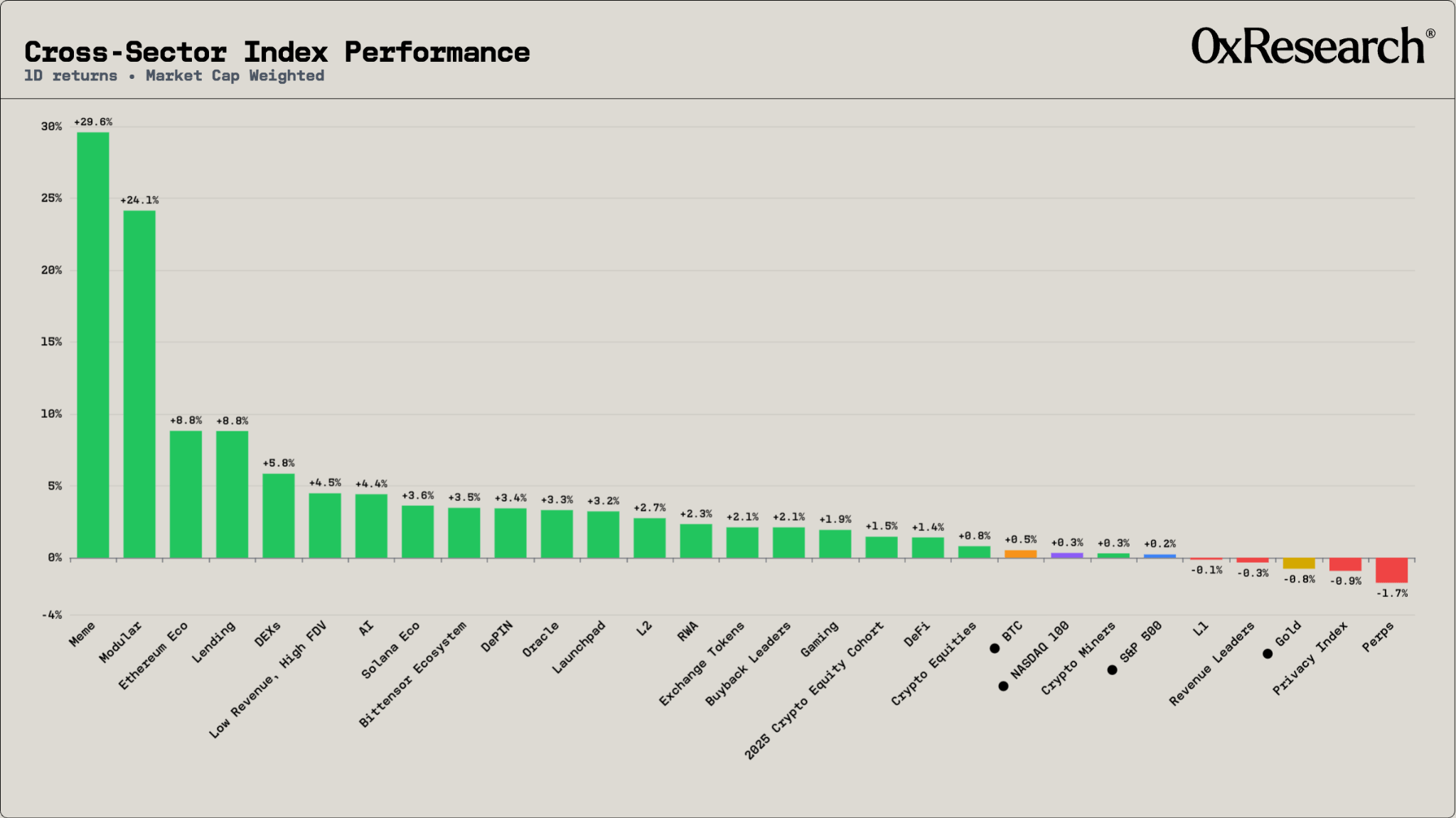
While the majors were relatively quiet, dispersion across crypto sectors was extreme. The Meme and Modular sectors absolutely dominated the tape, skyrocketing +29% and +24.1% on the day. Market breadth was generally constructive, with Ethereum Eco (+9.8%), Lending (+8.8%), and DEXs (+5%) also putting in strong showings. On the lagging end of the spectrum, Perps (-1.7%) and the Privacy Index (-0.8%) were the weakest performers.
Looking under the hood of the Modular sector's massive rally reveals highly concentrated outperformance. TIA did the heavy lifting for the basket, up +25% on the day.
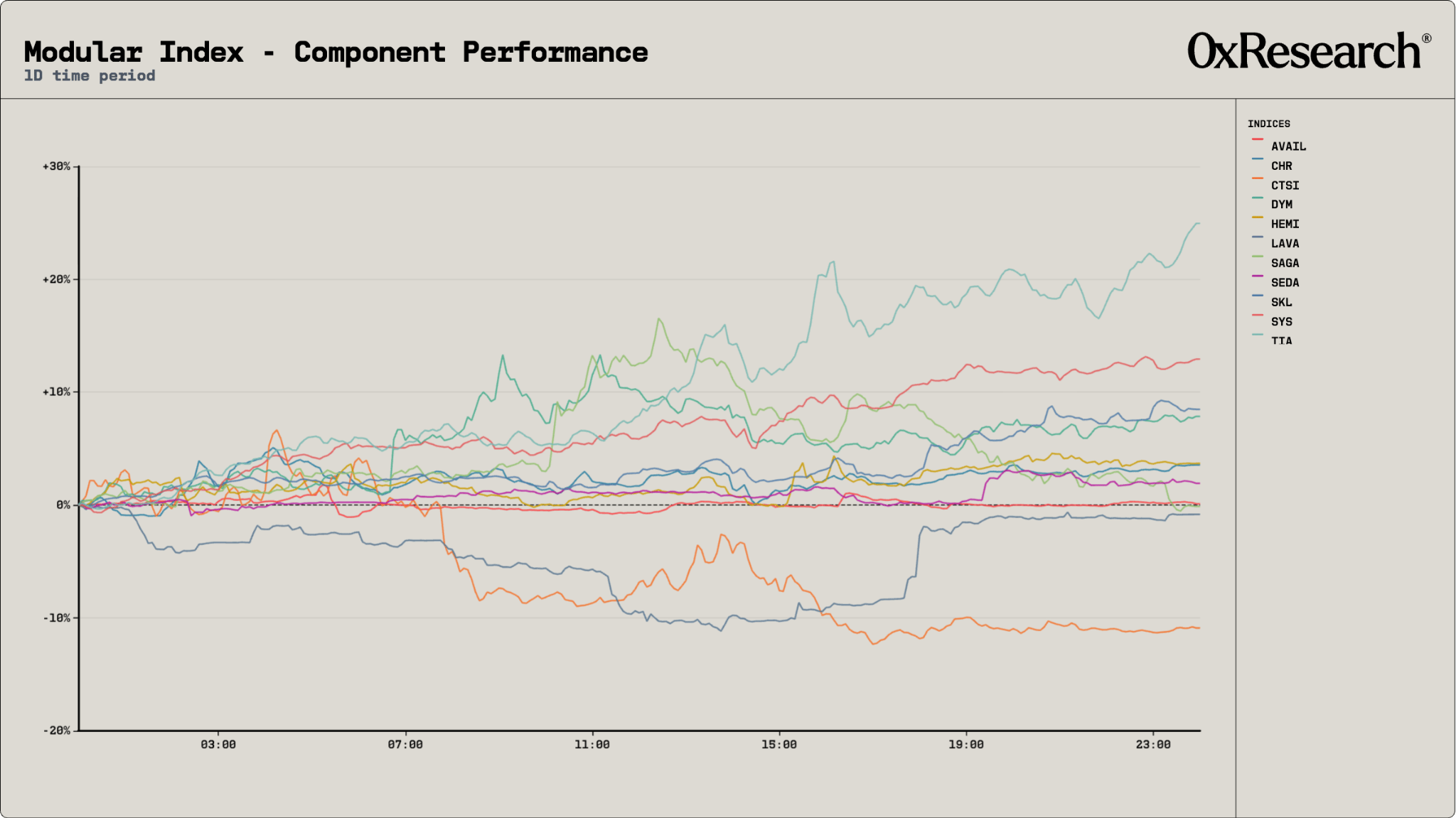
Celestia's V8 upgrade (including Hibiscus) is now live on the Mocha testnet, which will soon bring single-signature cross-chain transfers and ZK-verified messaging to mainnet. The subsequent upgrade will further expand blockspace capacity by introducing 3-second block times and 32 MiB blocks, clearing the path for Fibre — a high-throughput protocol targeting 1 GB/s in its first iteration. SYS and SKL also saw strong inflows, posting gains of +12.9% and +8.5% respectively. Conversely, CTSI was the clear outlier to the downside, tumbling -10.9% while the rest of the modular cohort moved higher.
As we head into the weekend, the key question is whether this aggressive rotation into high-beta narratives like Memes and Modular infrastructure can sustain its momentum or if it will face the weekend depth degradation and liquidity discounts frequently seen in off-hours trading.
— Shaunda
Tether's Drift Bailout
Drift was drained of about $295M on April 1 after attackers spent months posing as a quant firm, took control of the protocol, and emptied major vaults.
Funds were bridged out via Circle’s CCTP and were not frozen during the incident, which Tether has now turned into an opportunity. Today, Drift and Tether announced a recovery package of up to ~$147.5M ($127.5M from Tether, $20M from other partners), with Drift set to replace USDC and relaunch with USDT as its settlement layer. (Circle maintains its policy is to act in response to court orders and not serve as de facto onchain police.)
The bulk of Tether’s commitment is a $100M revenue-linked credit facility, with the package also including ecosystem incentives and loans to market makers. Impacted users will receive transferable recovery tokens representing claims on a pool funded by future trading revenue plus the committed capital.
The stablecoin backdrop explains why. USDC's share of Solana stablecoin supply has slid from an ~80% peak in February 2025 to ~54% today, while USDT has moved higher from ~18% to ~22% over the same window. Drift’s move to USDT should reinforce that trend, even as Solana’s stablecoin mix is already broadening beyond just USDC and USDT.
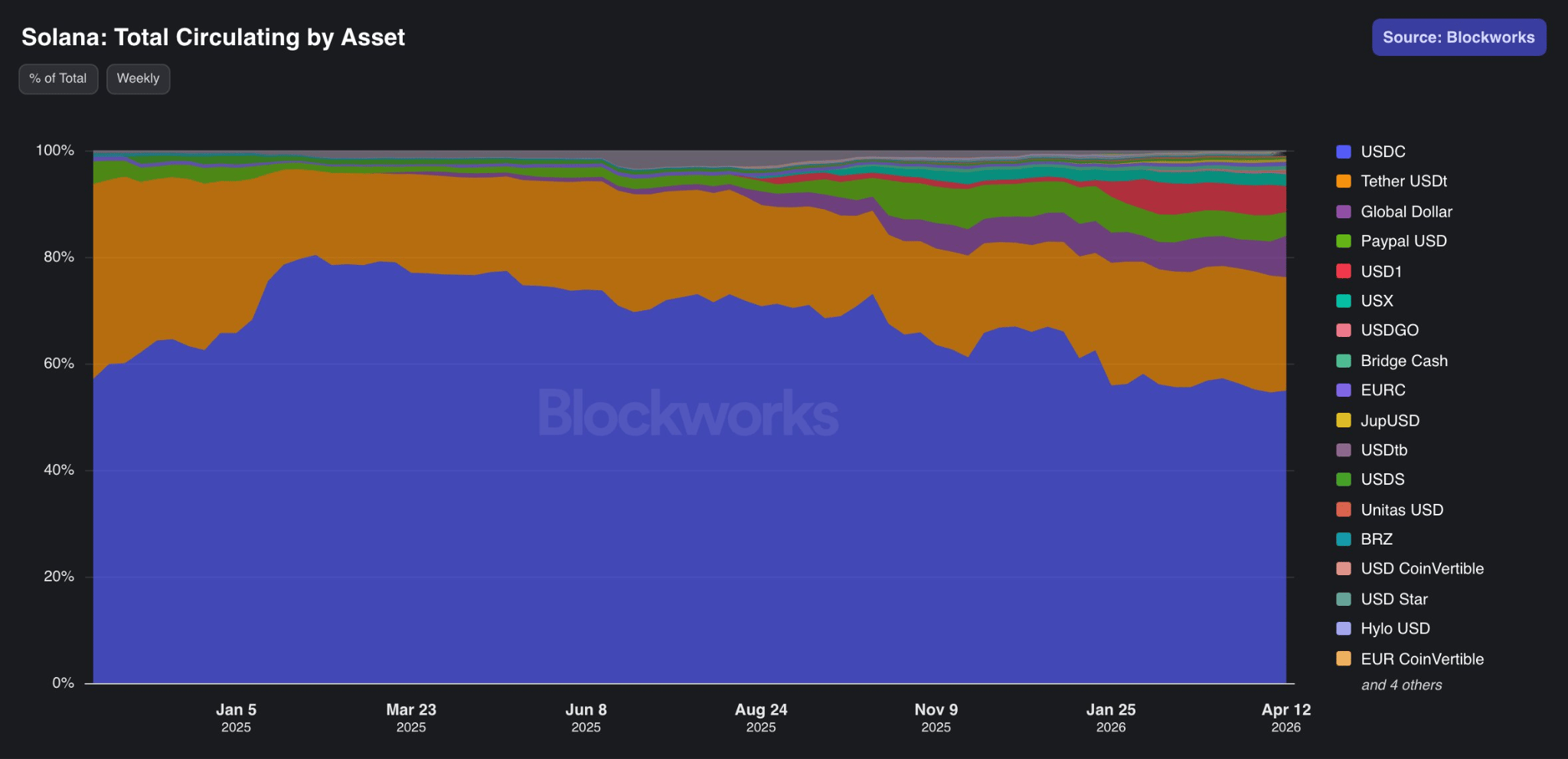
Hence, Tether is turning Circle’s weak freeze optics into distribution. A Drift relaunch shifts settlement to USDT, expands its reach across the Solana ecosystem, and gives Tether a clear strategic momentum shift.
Consequently, USDT/USDC saw a dramatic rise in activity on Solana prop AMMs, flipping SOL/USDC as the most-quoted pair.
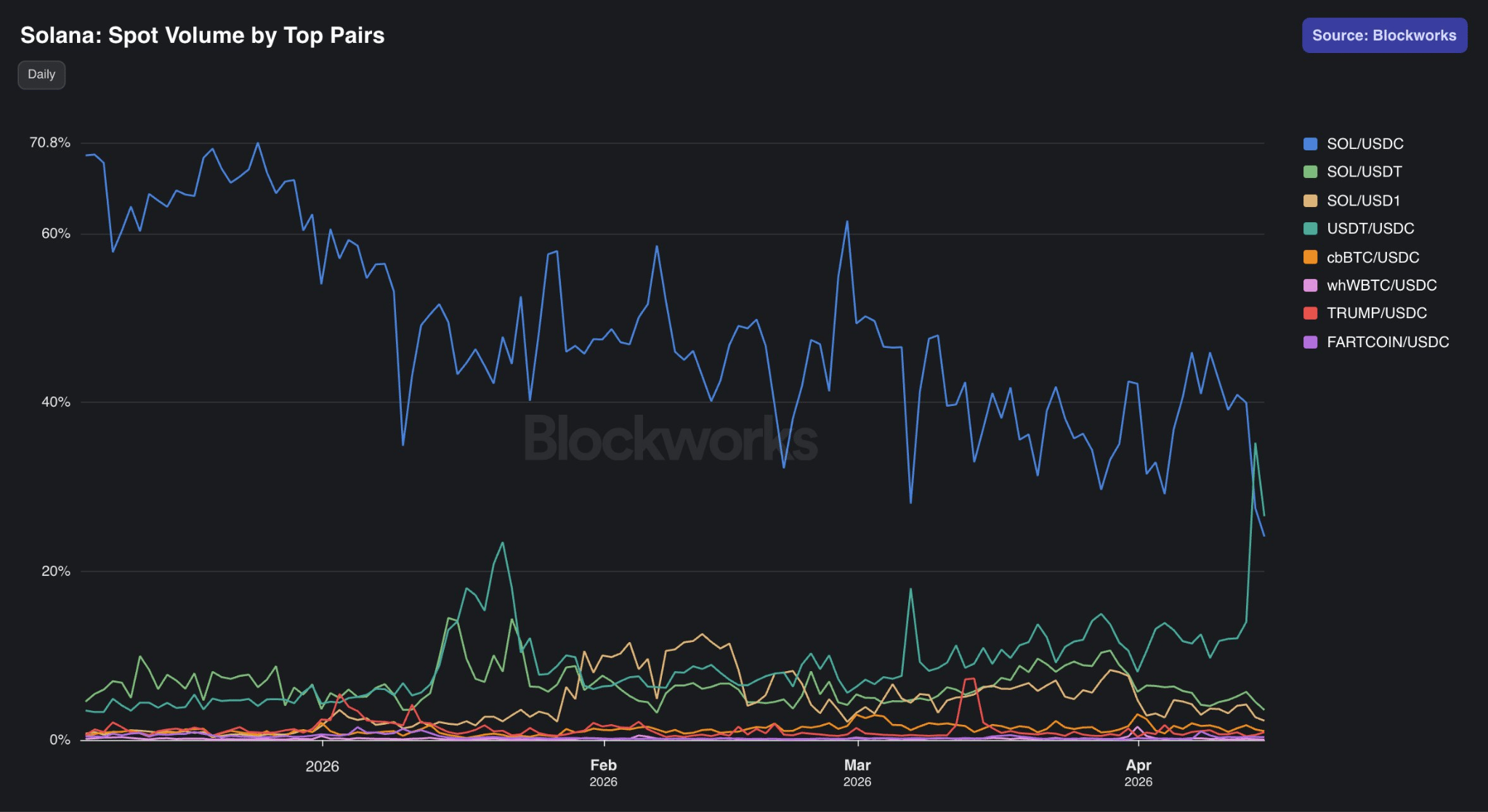
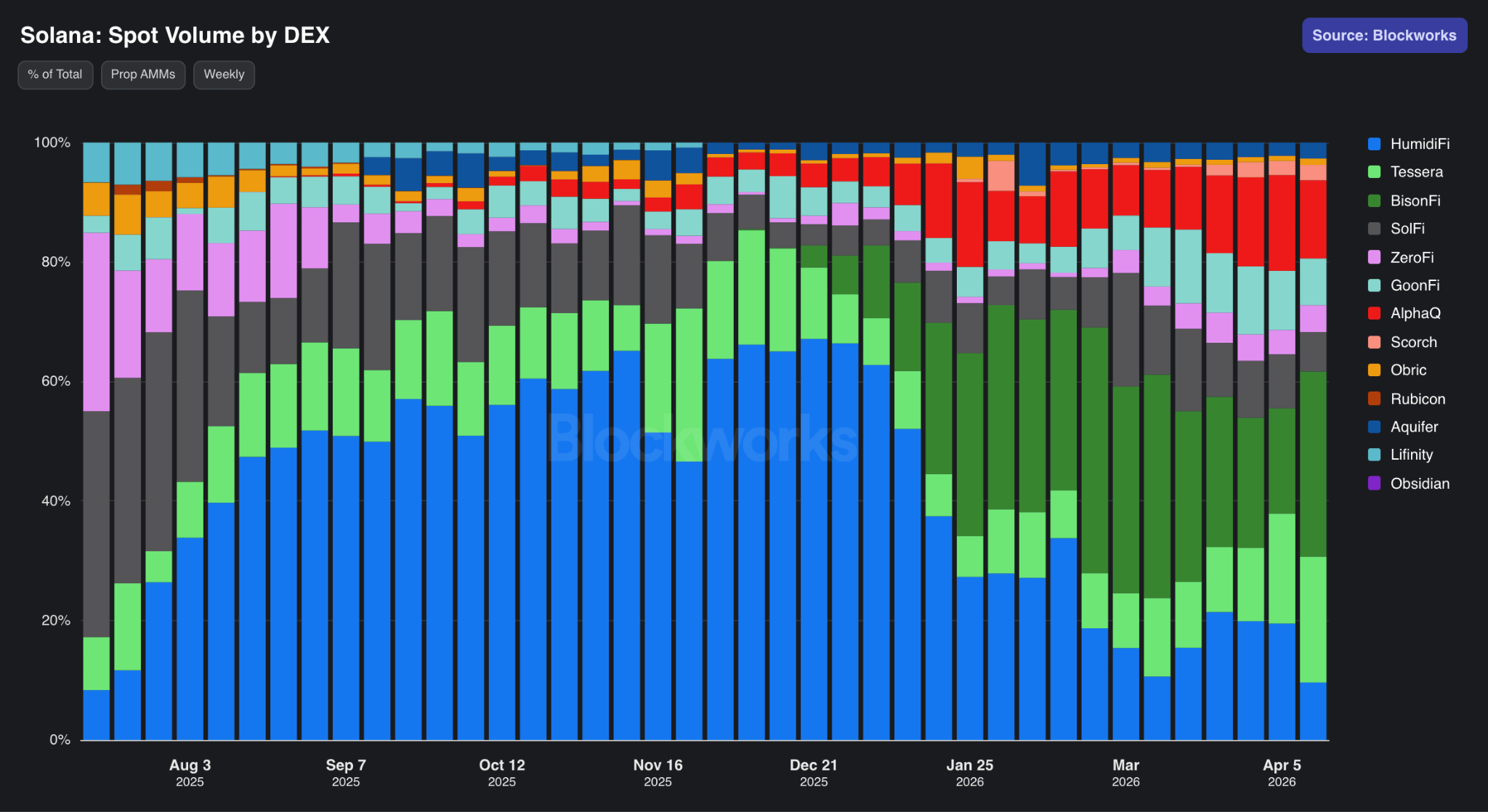
Prop AMMs provide the tightest quotes on the most liquid pairs like USDC/USDT because they can hedge inventory offchain instantly and capture a spread with minimal adverse selection, which makes the fight for top-of-book flow ruthless when competing through DEX aggregators like Jupiter and Titan. Currently, BisonFi, Tessera, and AlphaQ have overtaken HumidiFi at the top of Solana's prop AMM stack as competition continues to intensify.
— Sam

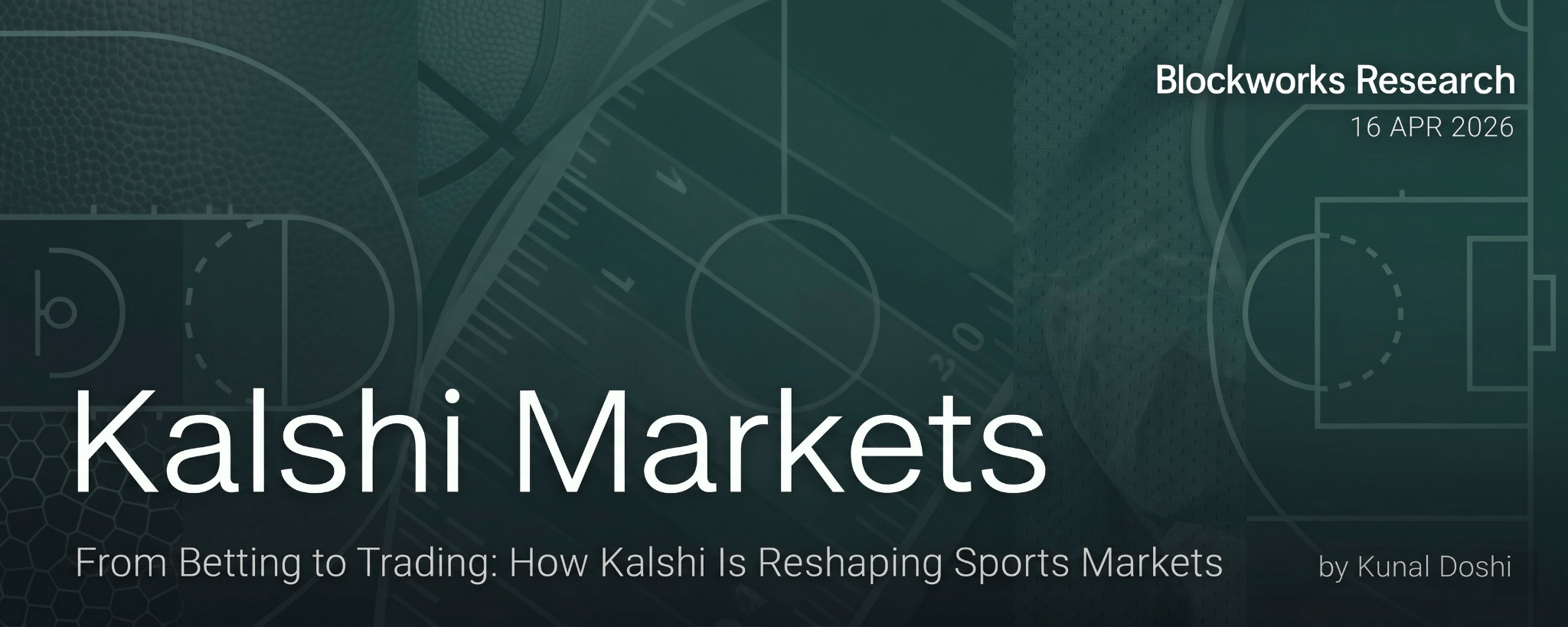
Blockworks Research’s Kunal Doshi unpacks Kalshi's 80x run to $14.4B in monthly notional, with sports at 68% of the book and ~70% category share. Across 3.1K games, implied probabilities two days out deviate from realized outcomes by just 5.5 percentage points, tracking FanDuel at a 0.9962 in-game correlation.
The catch is execution: in-game depth drops to 16.3K contracts versus a 73K pre-game peak, and Kalshi's 7% takers blend to 2.8% to 4.2% effective cost, against Polymarket's 3% takers and a $5M April liquidity push. The report frames Kalshi's ~$22B / 16.9x forward 2026 P/S as an exchange multiple, not a sportsbook multiple like DKNG and FLUT at 2x to 4x.
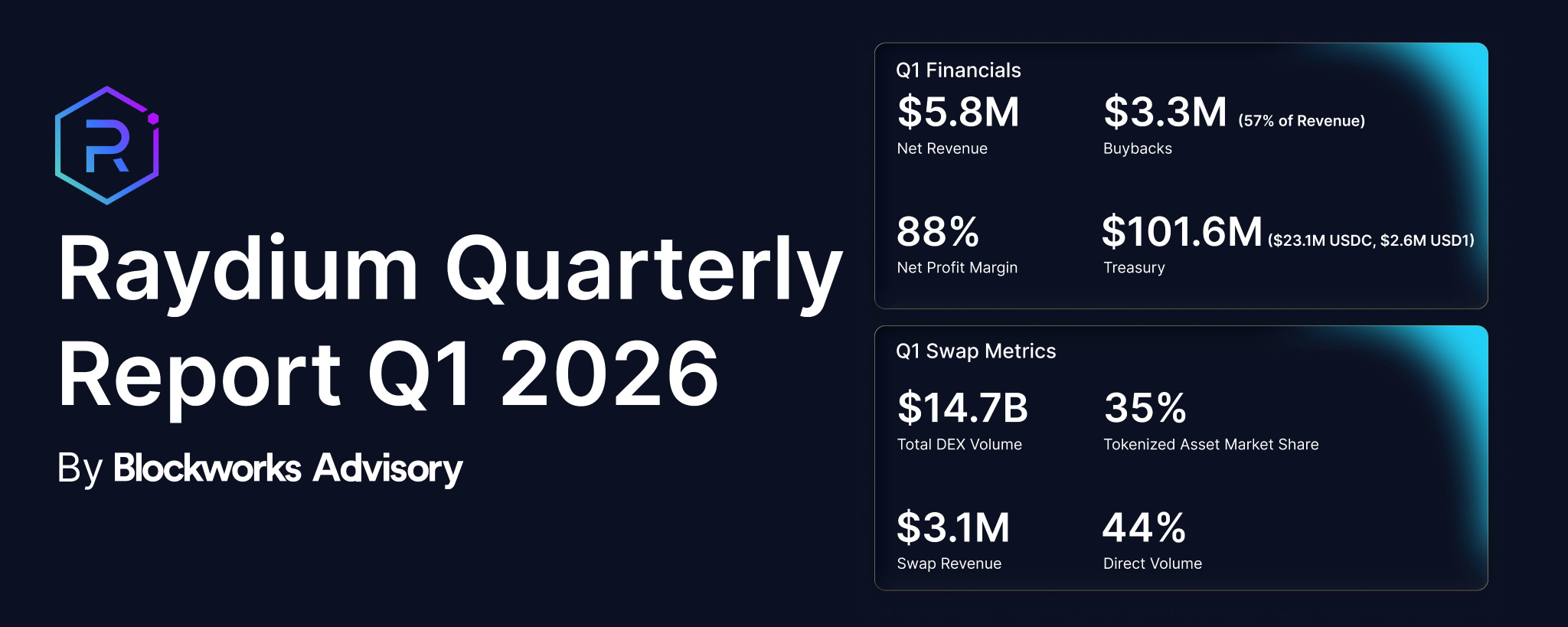
Blockworks Research frames Raydium's Q1 as internal rotation rather than deterioration: net revenue of $5.79M (-20.6% QoQ) masks LaunchLab rising 60.5% to $2.46M (42.5% of mix versus 21.1% in Q4) as swap revenue fell 42.5% to $3.10M against a -19.4% Solana DEX volume backdrop.
CLMM held as the stabilizer at 63.2% of swap revenue, Bonk Fun drove 95.8% of LaunchLab flow, and 87.6% net margins funded $3.31M of buybacks. Treasury closed at $101.6M with $25.2M in stablecoin reserves, leaving Q2 runway intact and payout intensity easing to 61.1% from 79.6%.
Introducing Blockworks Investor Relations, an IR platform built for onchain businesses.
The latest Blockworks offering brings together analytics, a branded investor relations site, and integrated advisory support into a single platform. The result is a more efficient way to share your story, build trust with investors, and engage a global audience from day one.
Check out our cofounder Michael Ippolito's keynote at DAS NYC launching the new IR platform.