- 0xResearch
- Posts
- Pre-IPO heats up
Pre-IPO heats up
PreStocks drive Solana equity volumes to all-time highs


Daniel Shapiro & Carlos
April 14, 2026

Hi all, happy Tuesday! Crypto finally got a session where strength was not confined to a couple of crowded corners. BTC outperformed major benchmarks and leadership spread into more of the board.
That shift in risk appetite comes as another niche market is starting to wake up. On Solana, tokenized pre-IPO names are pulling real trading activity and giving retail a new way to chase private-company exposure before those assets ever reach public markets.

The rally has finally broadened, and Monday’s close looked better than yesterday’s framing. BTC rose 5.5% on April 13, beating SPY’s 2.1%, QQQ’s 2.5%, and gold’s 2.0%, which tells you crypto did more than just survive another macro-heavy session. The stronger signal was that capital moved back into the asset class with real breadth behind it.

That breadth was the biggest change. 24 of 25 tracked BWR sectors finished green, and leadership came from parts of the board that had not been driving the prior issue. Lending led at 14.2%, followed closely by Ethereum Eco at 14.1% and DeFi at 10.1%. The 2025 Crypto Equity Cohort added 10.0%, Crypto Miners still gained 9.5%, and even Perps finished up 8.4%. The Meme sector was the only real loser, down 2.8%.
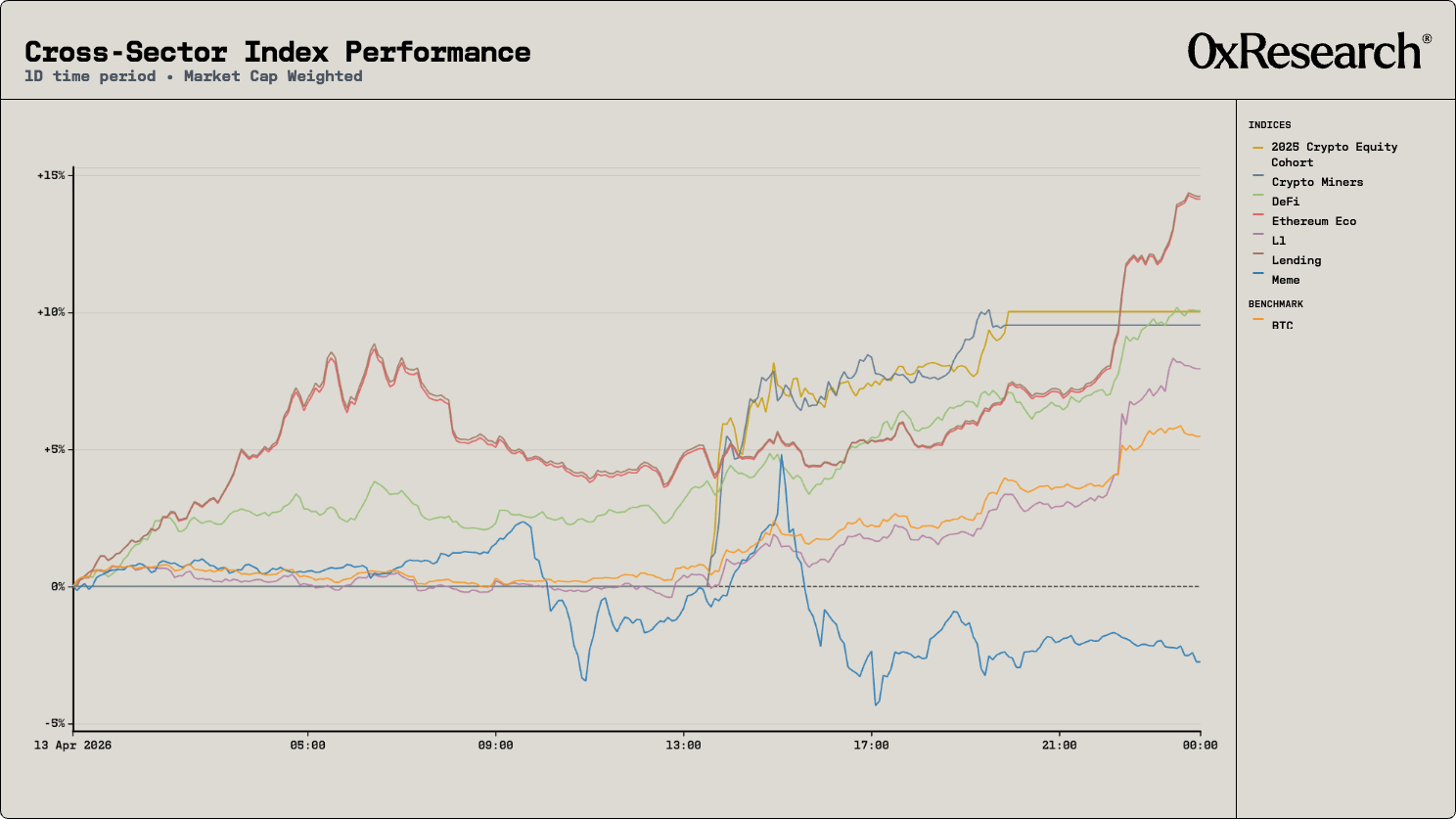
That mix matters because yesterday’s 0x issue was built around oil, blockade risk, and miners as AI-infrastructure beta. Monday’s close did not reject that trade, but it clearly widened the field. Ethereum-linked beta, Lending, and DeFi all moved harder than Miners, which is a cleaner sign of crypto-native risk appetite over another single-sleeve squeeze.
If Tuesday keeps that hierarchy intact, with BTC still beating benchmarks and Ethereum-linked sectors still ahead of the pack, the right read is broadening participation rather than another one-day headline chase. If that breadth narrows back to one or two sectors, treat Monday as a sharp bounce, not a reset.
— Daniel
Pre-IPO trading accelerates
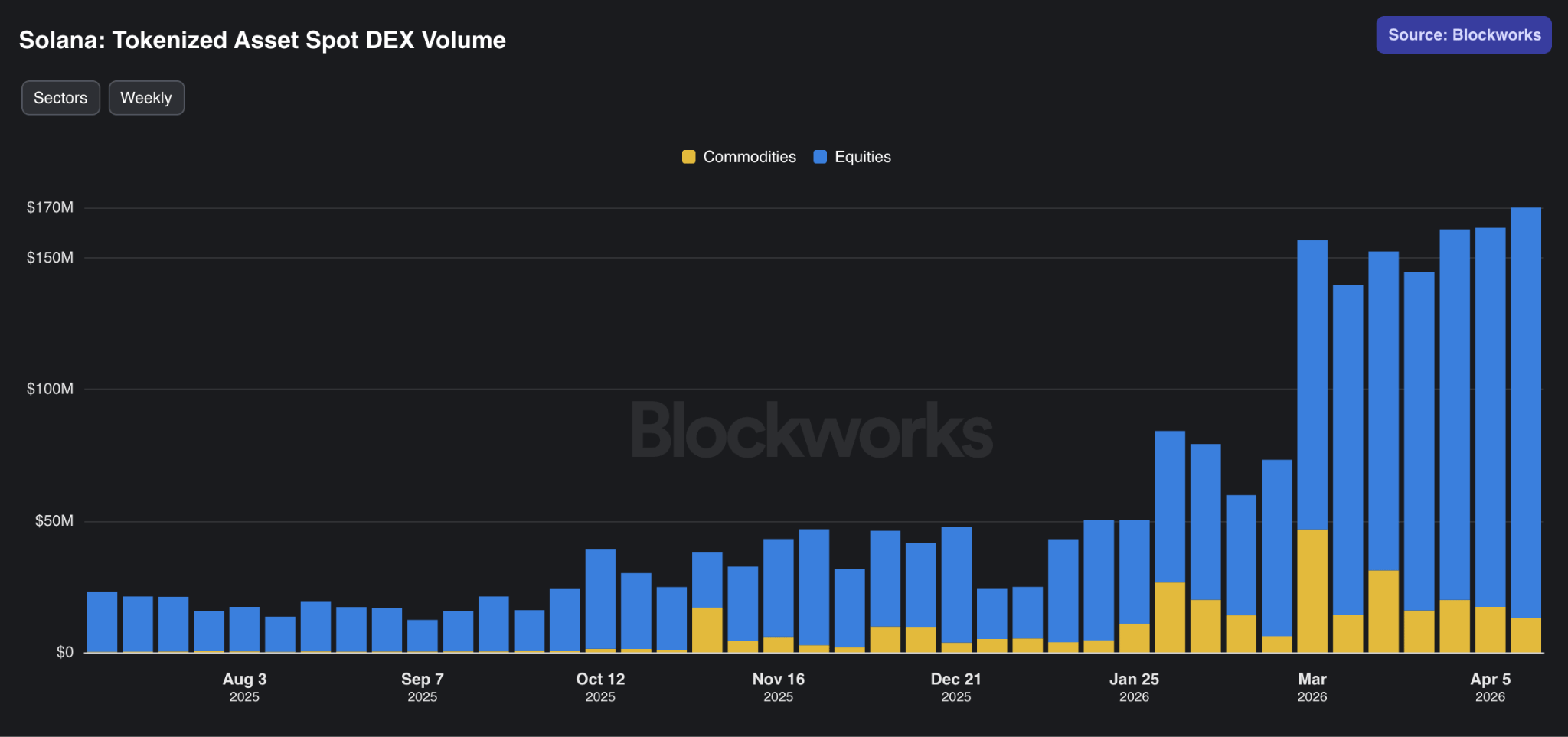
Last week, Solana recorded a new all-time high in weekly tokenized-asset spot DEX volume, reaching $169M. Notably, 92% of that volume came from equities, while the remaining 8% was driven by commodities, largely Tether Gold (XAUT). This marked the third consecutive week of record highs in tokenized-asset volume on Solana.
What stands out most, however, is what’s driving the equity side.
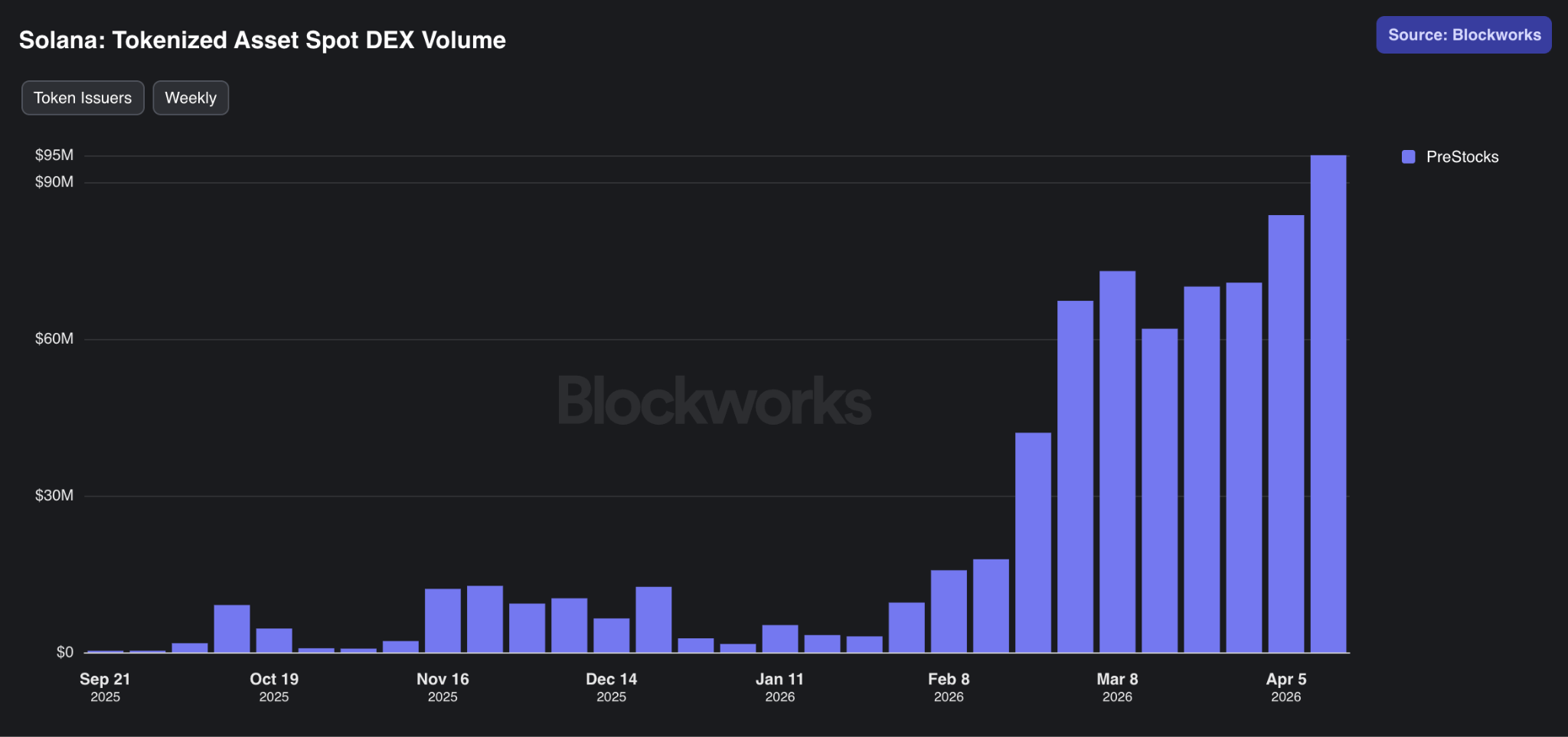
By issuer, PreStocks led the surge, accounting for roughly 50% of total tokenized volume, followed by xStocks (32%) and bridged assets via Wormhole (13%). While xStocks primarily offer exposure to publicly traded names like COIN and TSLA, PreStocks are focused on pre-IPO company exposure.

Even though it has remained a relatively niche market, last week marked an all-time high for PreStocks activity on Solana, with weekly volume reaching $95M. OPENAI accounted for 29.5% of that total, followed closely by SPACEX at 28.1% and ANDURIL at 20.9%.
Other PreStocks listings include Anthropic, Kalshi and Polymarket. Trading pre-IPO companies is quietly gaining traction, but still feels largely underdiscussed.
At a high level, PreStocks tokens are backed by baskets of SPVs that hold direct or indirect exposure to the underlying companies. For example, a single SpaceX token may be backed by multiple SPVs, each with some claim on SpaceX equity. Importantly, these tokens are not affiliated with, or endorsed by, the underlying companies themselves.
That structure raises a key question, which is pricing. Some of these tokens are trading at meaningful premiums to their underlying valuations. For instance, PreStocks-issued ANTHROPIC is currently trading at an implied valuation of ~$1.3T, roughly a 54% premium to secondary market estimates (~$844B), and over 200% above its most recent post-money valuation of ~$380B from its February raise.
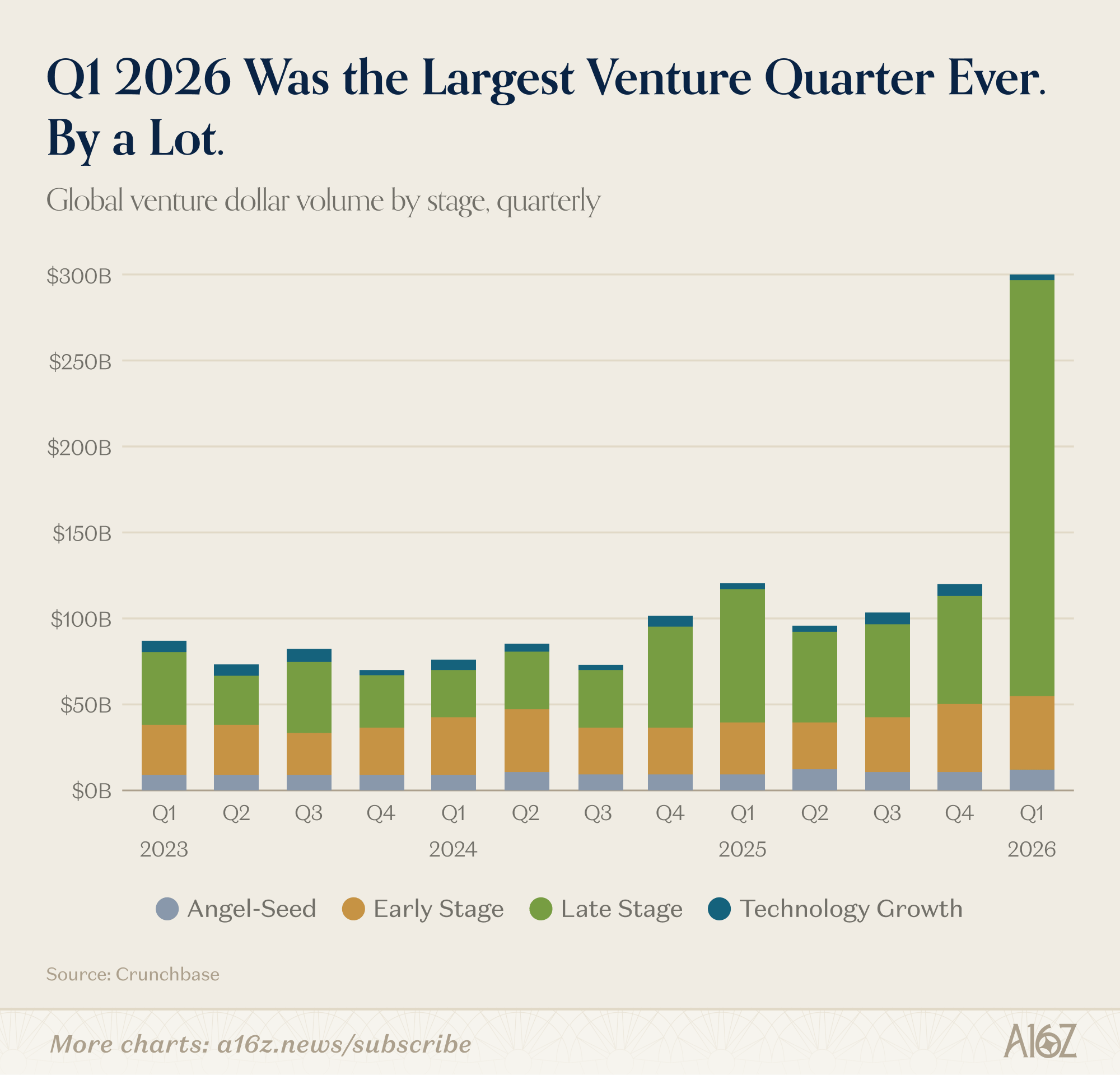
This disconnect likely reflects speculative retail demand. As a16z recently noted, Q1 2026 was the largest quarter for venture investment on record, with roughly $300B deployed across around 6,000 startups, up more than 150% both QoQ and YoY. OpenAI, Anthropic, xAI and Waymo alone accounted for about $188B, or roughly 65% of that total. As some of the world’s most valuable companies remain private for longer, retail investors are increasingly looking for ways to gain exposure.
The rise in both volumes and valuation premiums points to strong demand, even as the underlying mechanics remain largely untested. Pre-IPO tokenization may open up a new access point, but it also brings meaningful risks: opaque pricing, structural complexity, and the potential for persistent dislocations from underlying valuations. It is a space worth watching closely over the coming months.
— Carlos


Dom Cooke from Colossus profiles Hyperliquid through its founder, Jeffrey Yan. He frames the company as a rare “small team, massive outcome” story: an 11-person group in Singapore that built a high-performance onchain perps exchange and blockchain into one of the most profitable enterprises per employee, generating roughly $900M in profit last year without taking VC money.
The piece traces Yan’s path from running a highly profitable proprietary crypto trading shop to deciding that the post-FTX world needed a credibly neutral, transparent exchange stack — so he self-funded Hyperliquid, turned down a ~$100M VC round to preserve neutrality, and leaned into an obsessive “ship and iterate” culture. It then follows the costs of winning, such as attacks, copycat listings, and escalating competitive pressure, alongside operational crucibles like scaling market-maker connectivity and infrastructure under extreme volume and liquidation events. This forced Hyperliquid to harden its systems while keeping latency and UX competitive with top centralized venues.

Lucas Bruder from Jito published an article arguing that Solana has largely “won” the infrastructure debate, but the ecosystem is still stuck building memecoin-era apps optimized for the fastest in-and-out trade rather than for real users. Burder compares this to the early internet, where degenerate use cases proved the pipes worked before Amazon/Google emerged, and says Solana is now leaving that phase as Coinbase and Robinhood dissolve the walls between CEX and DEX and onboard mainstream users directly into onchain trading.
The problem, he argues, is the application experience: Many Solana apps feel like a noisy flea market versus the clean, legible UX standards people expect from fintech, so new users churn before they even start. He points to Hyperliquid as evidence that serious, well-crafted trading experiences can pull real volume and fees, and outlines the three gaps Solana must close: trust (instant intuitive feel), craft (polished edge cases), and durability (built for a decade, not a cycle).
Vaults promise to rebuild asset management from scratch and do it faster, cheaper, and in ways that are fully programmable. But the path from niche DeFi product to institutional backbone is far from straightforward. The Inflection Point crew sits down this week to unpack how vaults are evolving from crypto-native yield tools into a serious contender for institutional capital. They explore programmable funds, institutional adoption, risk and regulation, recent DeFi hacks, and what still needs to happen before vaults scale into a multi-trillion dollar opportunity.
Introducing Blockworks Investor Relations, an IR platform built for onchain businesses.
The latest Blockworks offering brings together analytics, a branded investor relations site, and integrated advisory support into a single platform. The result is a more efficient way to share your story, build trust with investors, and engage a global audience from day one.
Check out our cofounder Michael Ippolito's keynote at DAS NYC launching the new IR platform.