- 0xResearch
- Posts
- Polymarket’s fee switch
Polymarket’s fee switch
Monetization ramps with strong daily volumes


Sam Schubert & Kunal Doshi
April 03, 2026

Hi, everyone. As we approach the Easter weekend, markets are still navigating a mix of policy risk and geopolitical tension, with gold continuing to lead while BTC and equities struggle to find footing.
Crypto saw a mild rebound yesterday, but the bigger story remains the impact of the Drift exploit, which exposed just how interconnected the Solana DeFi stack has become.
We also dive into Polymarket’s fee switch and whether its current valuation can be justified as monetization ramps.

Yesterday, President Donald Trump signed an executive order threatening pharmaceutical tariffs of up to 100% on patented drugs from companies that don’t reach deals with his administration, exactly one year after Liberation Day tariffs reshaped global trade. CNN’s Fear and Greed Index now sits at 15 (extreme fear) as Iranian escalation and elevated oil prices also remain top-of-mind.
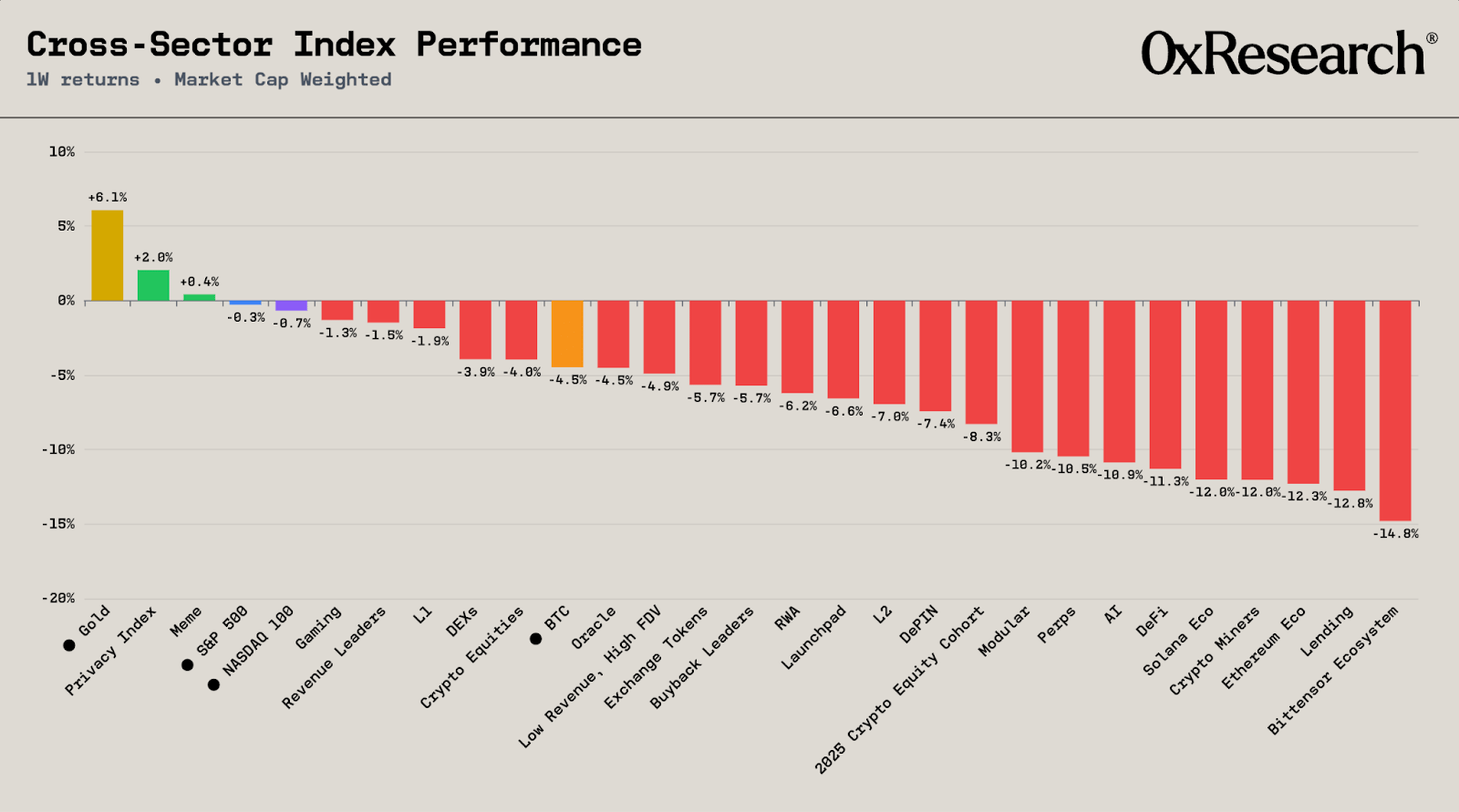
Correspondingly, gold led the weekly cross-sector chart at +6.1%, the only major asset class in the green alongside Privacy (+2.0%) and Memes (+0.4%). BTC lost 4.5% on the week, and the S&P slipped 0.3%.
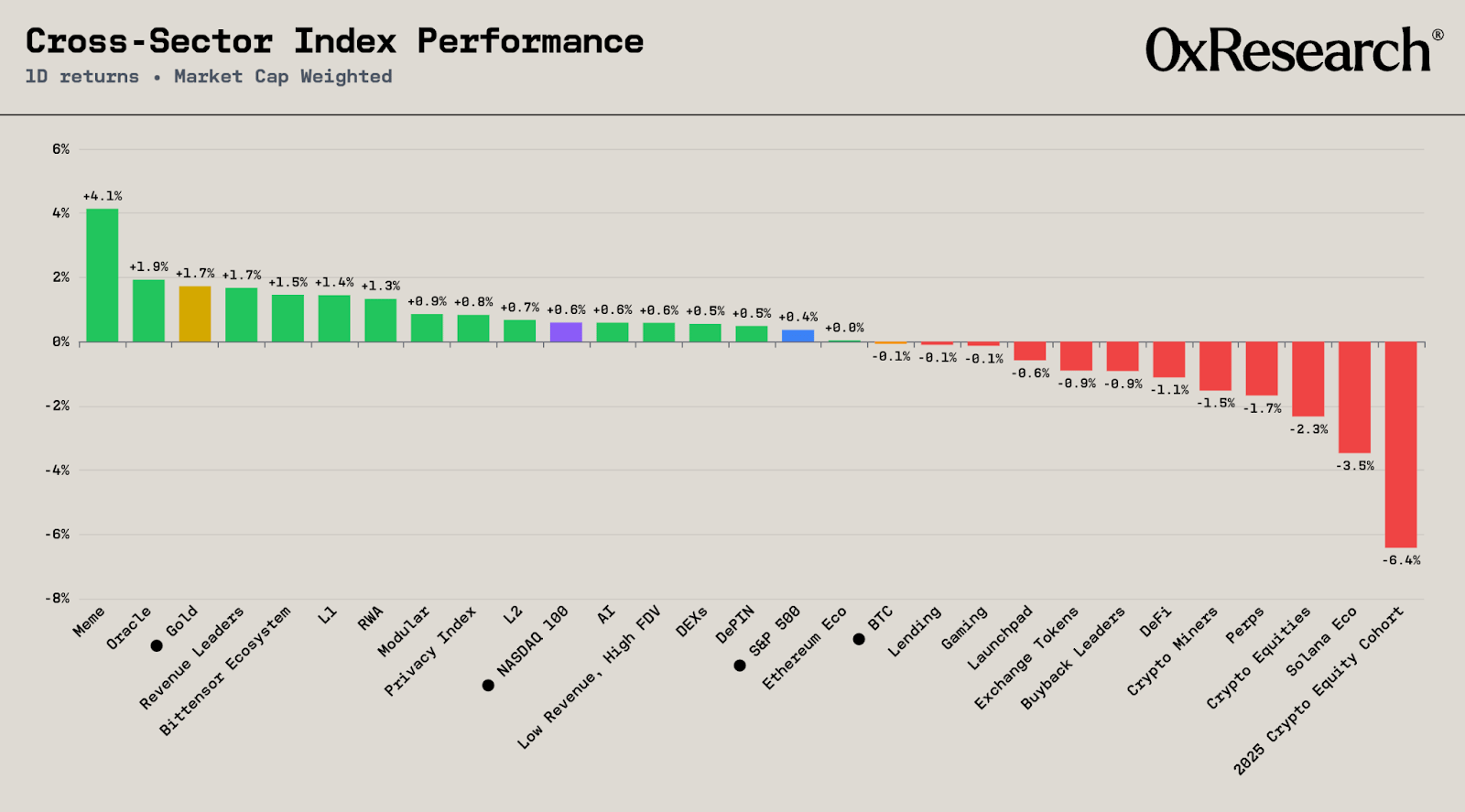
Yesterday’s session showed a mild bounce across most sectors. Memes led at +4.1%, with Oracle +1.9%, gold +1.7%, and Revenue Leaders +1.7% following. Most crypto indices clustered in the +0.5%−1.5% range. The clear underperformers were the Solana Ecosystem at −3.5% and Crypto Equities at −2.3%.
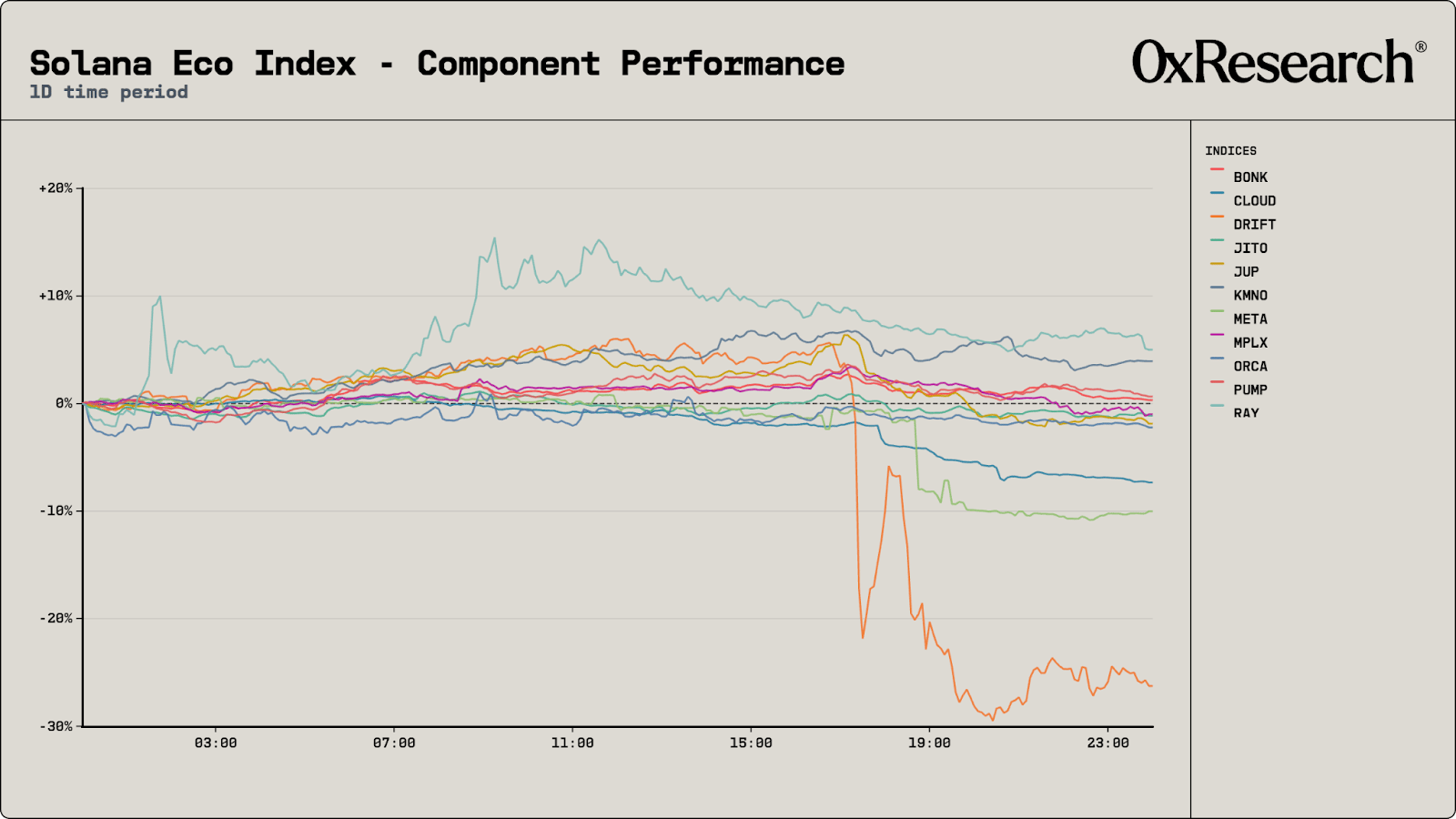
The Solana drag traces directly to Drift, down ~26% in yesterday’s session. The ~$290M exploit on April 1, the largest crypto hack of 2026, drained over half of Drift’s TVL in under an hour after an attacker used a compromised admin key and fake oracle token to manipulate vaults.
The damage bled across the ecosystem — Drift was deeply intertwined with Solana DeFi, running vaults and strategies that other protocols plugged into. A dozen projects with exposure paused operations or assessed losses, and the resulting confidence shock hit the broader Solana token complex, with META falling 10% and CLOUD off 7.4% on the day.
— Sam
The case for Polymarket’s valuation
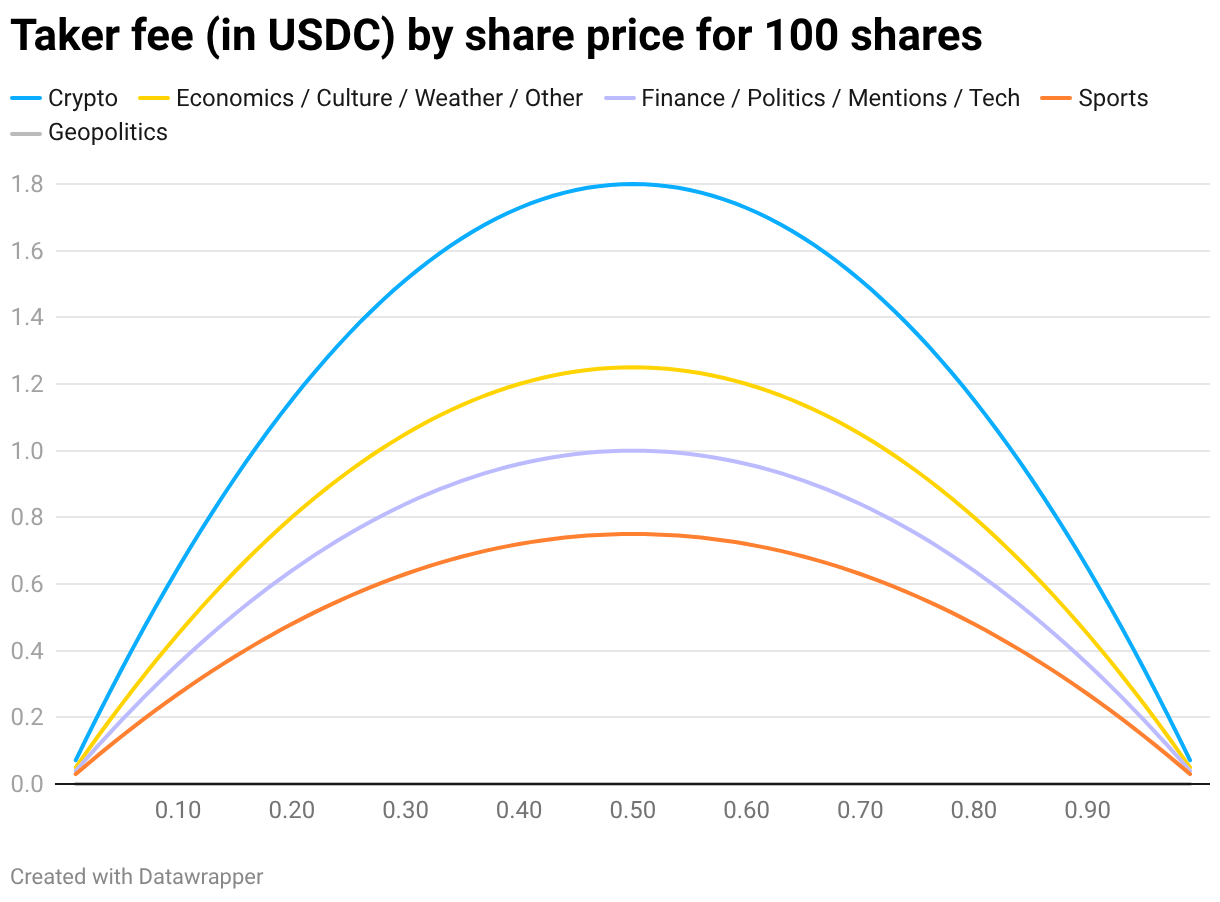
This week, Polymarket expanded its fee switch across most markets as it looks to justify the premium valuations that prediction markets have commanded over the past year. The initial rollout began in January 2026 with fees on 15-minute markets in crypto and select sports. As of March 30, fees now apply to taker orders across all markets except geopolitics and world events. A portion of these fees is redistributed to makers through rebates, with both fee rates and rebates varying by category.
The rollout was not without issues. Certain markets, particularly weather and economic contracts, saw unusually high fees, prompting immediate user backlash on X. The team responded quickly by updating the fee formula and removing the exponent that caused the spike.
Old formula: C × p × feeRate × (p × (1−p))^exponent
New formula: C × feeRate × p × (1−p)
Had the fee switch been applied retrospectively, Polymarket would have generated an estimated $7.8M in revenue over the past week, or $434M annualized based on the last four weeks. That implies a P/S multiple of 44.6x at the $20B valuation at which Polymarket was in talks to raise.
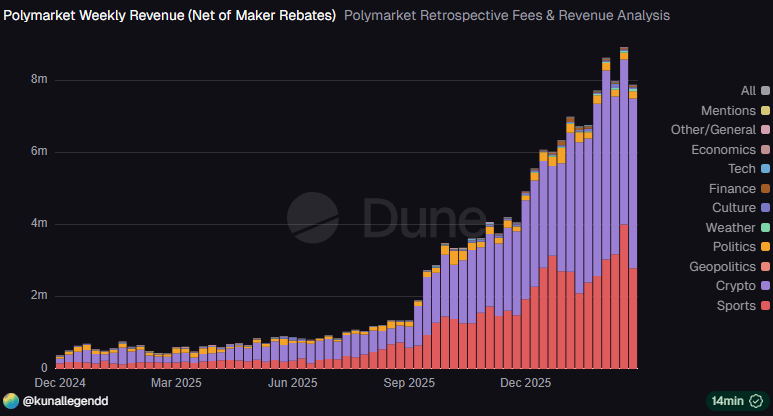
The structure of the fee model is also important. Fees are highest when market probabilities sit near 0.50 and lowest near 0 or 1, effectively creating a mid-curve tax where trading is most expensive when outcomes are most uncertain.
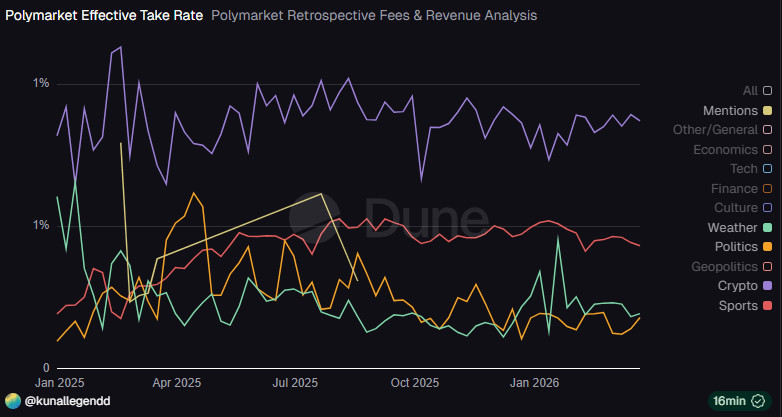
Revenue concentration is another key takeaway. Crypto and sports markets account for the majority of revenue, while politics contributes far less despite meaningful volume. The reason is structural: Political markets tend to trade at the extremes, resulting in a lower effective take rate, while crypto and sports markets spend more time near the middle of the curve where fees are highest.
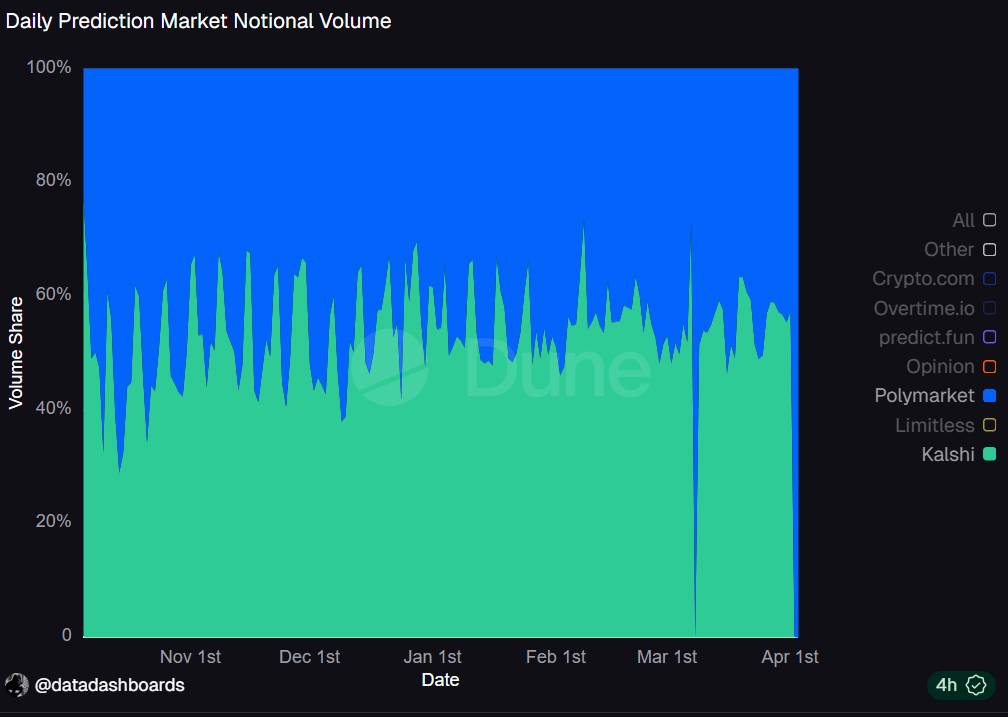
Since implementation, volumes have remained resilient at around $300M daily, with no meaningful loss of share to competitors like Kalshi. In just four days, Polymarket has already generated $3.4M in revenue, implying a 64x P/S on a forward basis.
Momentum also continues on the product front. Polymarket announced plans to launch traditional asset markets, including up-down contracts on equity indices, commodities, and single-name stocks. This was followed by a partnership with LALIGA as its exclusive prediction-market partner.
While these multiples may seem elevated, they become easier to justify given Polymarket’s rapid pace of growth and consistent month-on-month expansion in volumes. With fees now live and new markets rolling out aggressively, the focus has shifted from pure growth to monetization, and Polymarket is starting to deliver on both.
— Kunal


Nick Carpinito from Blockworks Research examines COIL (Collateralized Onchain Infrastructure Lending), where onchain capital finances physical infrastructure that banks won’t touch below ~$50M deal size. Three archetypes emerge: direct lending (USD.AI, GAIB), crowdfunding (Glow), and integrated DePIN financing (Daylight), each with fundamentally different risk profiles that investors are currently mispricing as equivalent.
No COIL protocol has publicly worked through a default, the critical unknown for an asset class targeting a $1.5T financing gap in data center capex through 2028. Aave’s Horizon and Framework’s $1B Obex mandate signal institutional capital is already routing toward COIL protocols as origination rails.
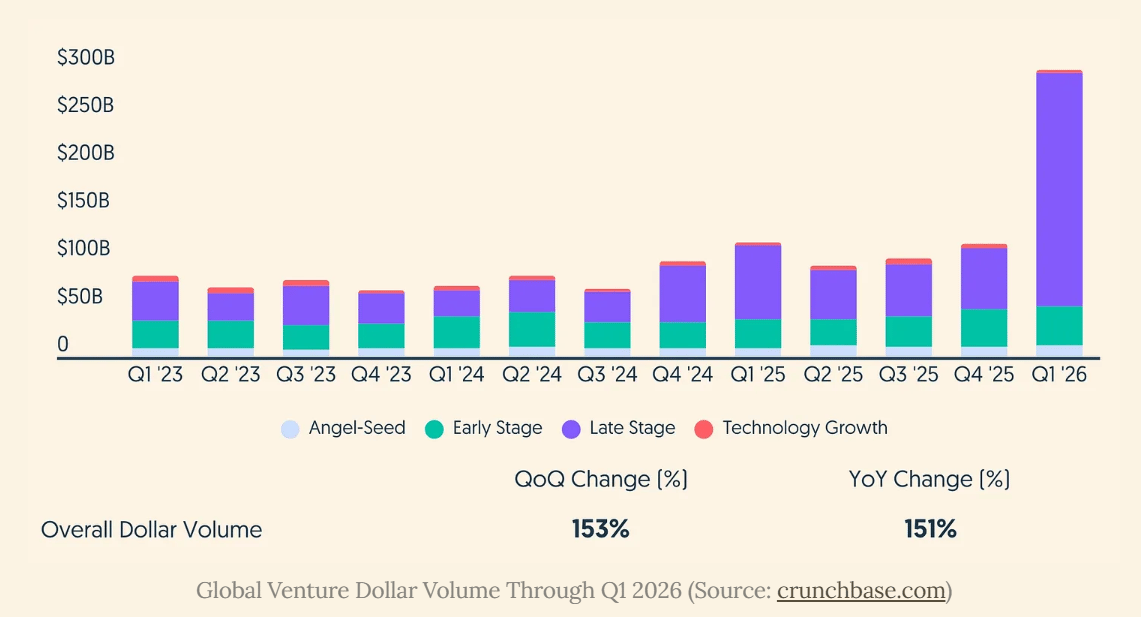
The report argues that Q1 2026 venture capital was not a broad recovery but a highly concentrated regime dominated by AI mega-rounds. Headline funding reached record levels around $300B, but a handful of deals accounted for most of the capital, with AI alone capturing roughly 80% of total investment. The market showed a barbell structure in which late-stage strategic platforms absorbed capital while early-stage breadth remained weak. Crypto funding improved, but stayed small and narrowly focused on stablecoin payments and regulated infrastructure rather than a full-cycle rebound.
The report’s core view is that venture in 2026 is defined by concentration and dispersion, with capital flowing to a few systemically important themes while most startups still face constrained funding conditions.

Introducing Blockworks Investor Relations, an IR platform built for onchain businesses.
The latest Blockworks offering brings together analytics, a branded investor relations site, and integrated advisory support into a single platform. The result is a more efficient way to share your story, build trust with investors, and engage a global audience from day one.
If you’re building in crypto and want to upgrade your investor relations function, we’d love to work with you. Book a meeting with the Blockworks team to get started.