- 0xResearch
- Posts
- Narrow leadership

Crypto bounced Thursday, but the tape still showed the same underlying message: Capital is willing to chase a narrow set of token-native winners, while more fragile expressions of the trade continue to lag.
That split showed up both in markets — where AI and DePIN led, while crypto equities sold off on idiosyncratic weakness — and in market structure, where Solana perps still look constrained by execution quality rather than demand alone.
Crypto markets sold off sharply overnight on fresh fears of a prolonged Middle East conflict. The drop followed a modest rebound Thursday, with BTC +1.09% and broader crypto showing a more constructive tone after the recent weakness. The move was not particularly aggressive but, importantly, came with improved sector breadth relative to prior sessions.
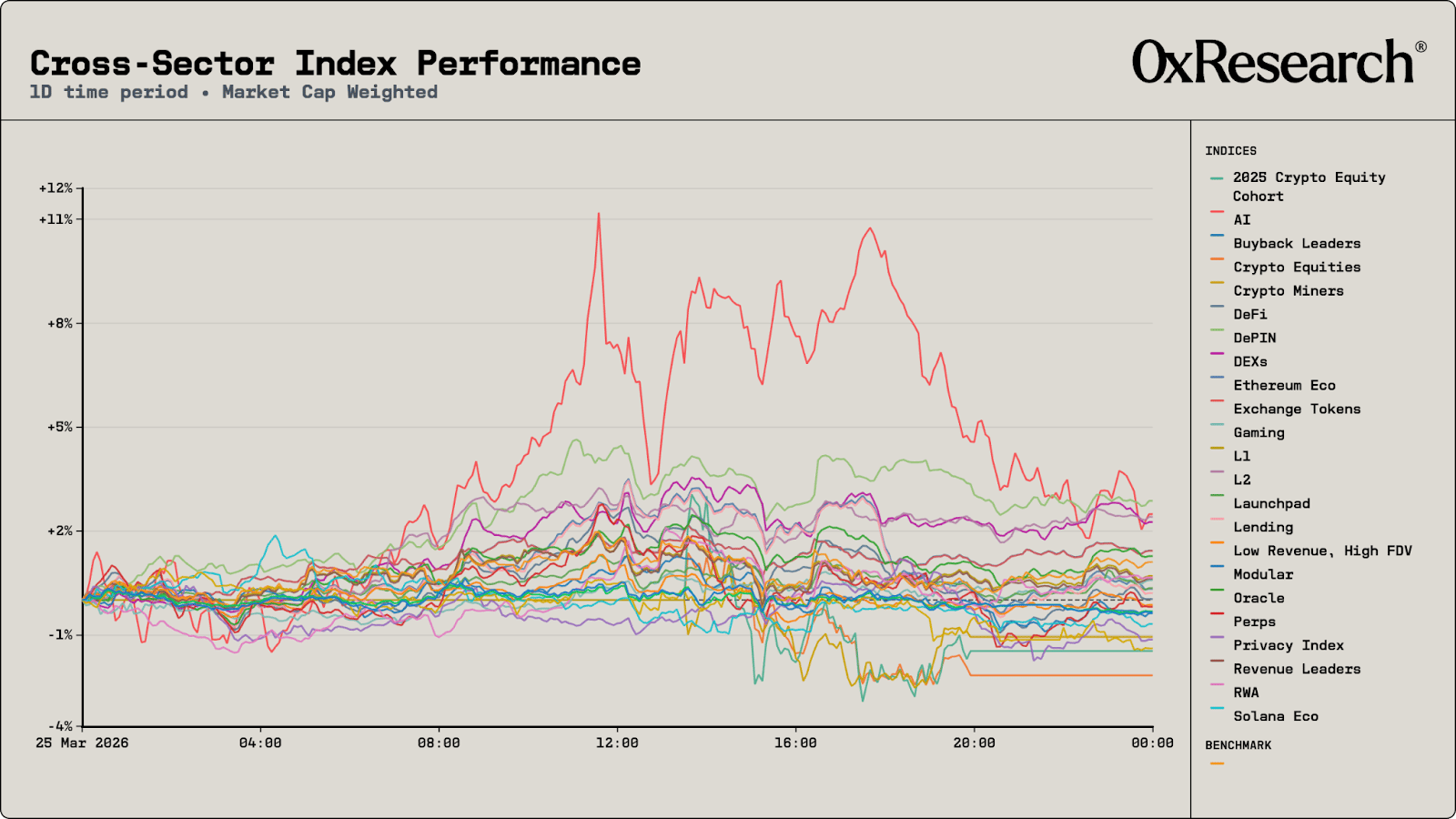
Dispersion remained elevated across sectors. DePIN led (+2.86%), followed by AI (+2.48%), L2s (+2.40%) and DEXs (+2.25%), suggesting a rotation back into higher-beta narratives rather than purely defensive positioning. Perps (−0.20%) and low-revenue/high-FDV names (−0.14%) lagged, reinforcing that speculative flow is still selective rather than broad-based.
At the index level, crypto equities (−2.18%) and the 2025 crypto equity cohort (−1.48%) underperformed.
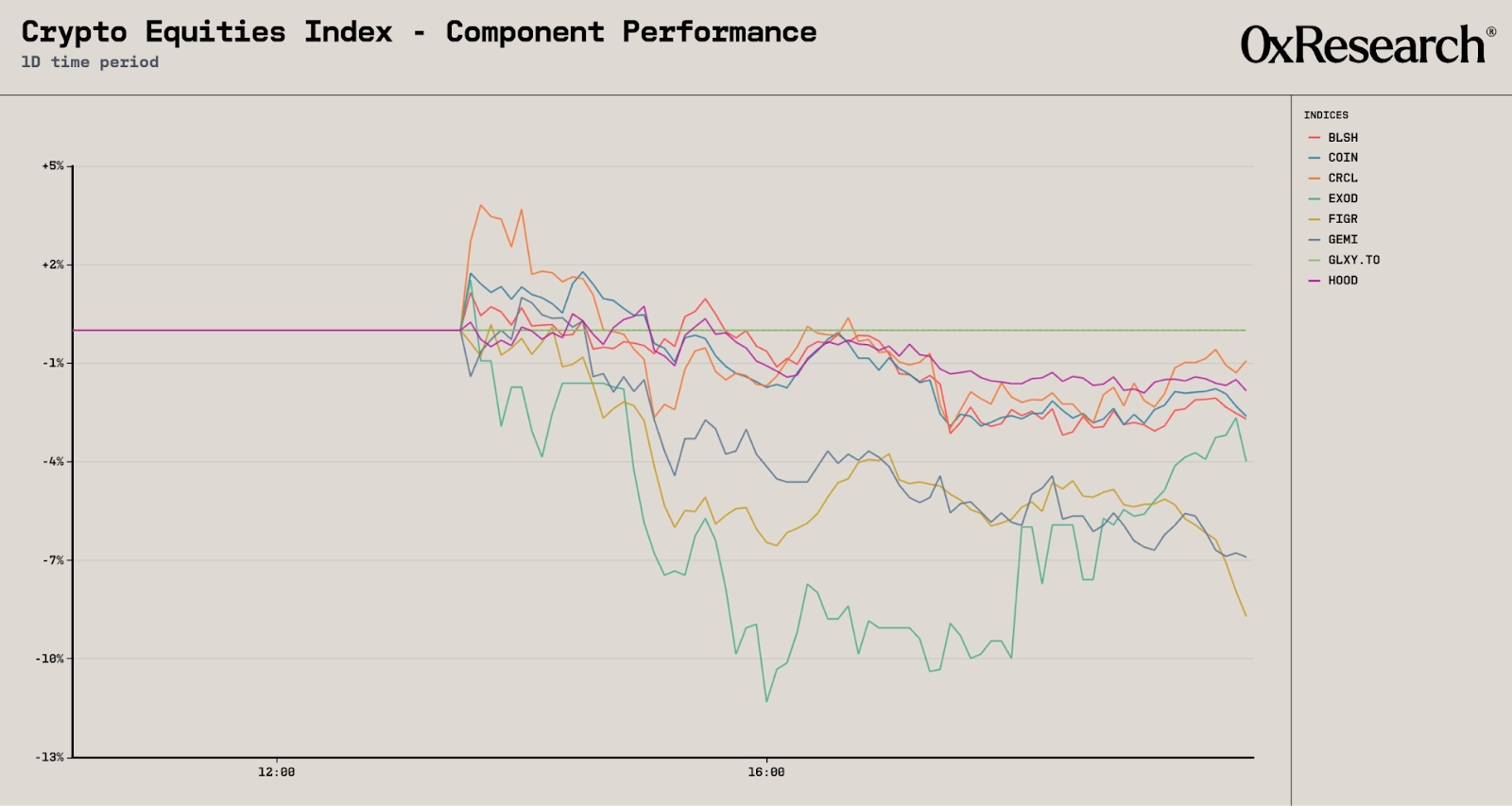
Crypto equities lagged on largely idiosyncratic weakness. FIGR remained under pressure after its earnings miss and target cuts, GEMI was weighed down by litigation and a weak print, and EXOD continued to fade following disappointing results earlier this month. Rather than giving a clean signal on crypto, the move reflected stock-specific earnings and balance-sheet risk across the basket.

Introducing Blockworks Investor Relations, an IR platform built for onchain businesses.
The latest Blockworks offering brings together analytics, a branded investor relations site, and integrated advisory support into a single platform. The result is a more efficient way to share your story, build trust with investors, and engage a global audience from day one.
If you’re building in crypto and want to upgrade your investor relations function, we’d love to work with you. Book a meeting with the Blockworks team to get started.
Solana’s perps-execution gap
The cost-and-pricing problems on Solana perps are not just application-layer issues. They are downstream of architectural constraints, such as: no maker-specific execution guarantees at the protocol level, an inconsistent leader-based block production model, and a priority fee market that cannot guarantee inclusion.
Without reliable execution, MMs have no reason to quote tight, books stay thin, spreads stay wide, and flow migrates.
Matching thousands of fills on Drift (the only major Solana venue live with an onchain perps orderbook) to Binance Futures ticks by timestamp segmented by validator client, saw effective spreads landed within 1bp regardless of builder across BTC and SOL.
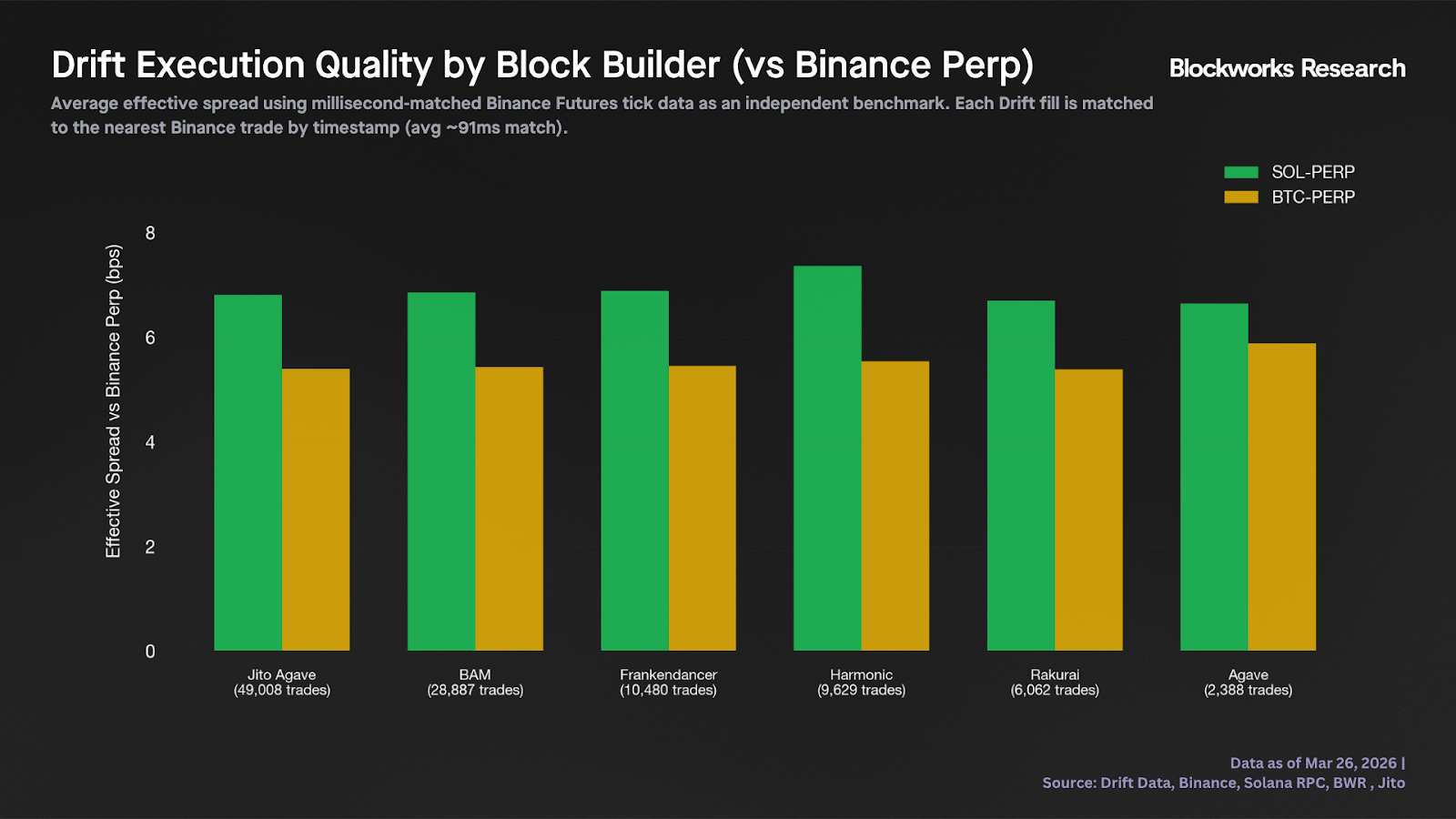
Leaders rotate every four slots (~1.6 seconds). Builder-aware quoting is theoretically possible since schedules are public each epoch, but toggling parameters across hundreds of rotations makes it impractical at scale. This suggests it is unlikely any single validator client can fix this on its own and that the solution may need to come at the protocol level.
The validator landscape itself is fragmented across six clients, as we can see below.
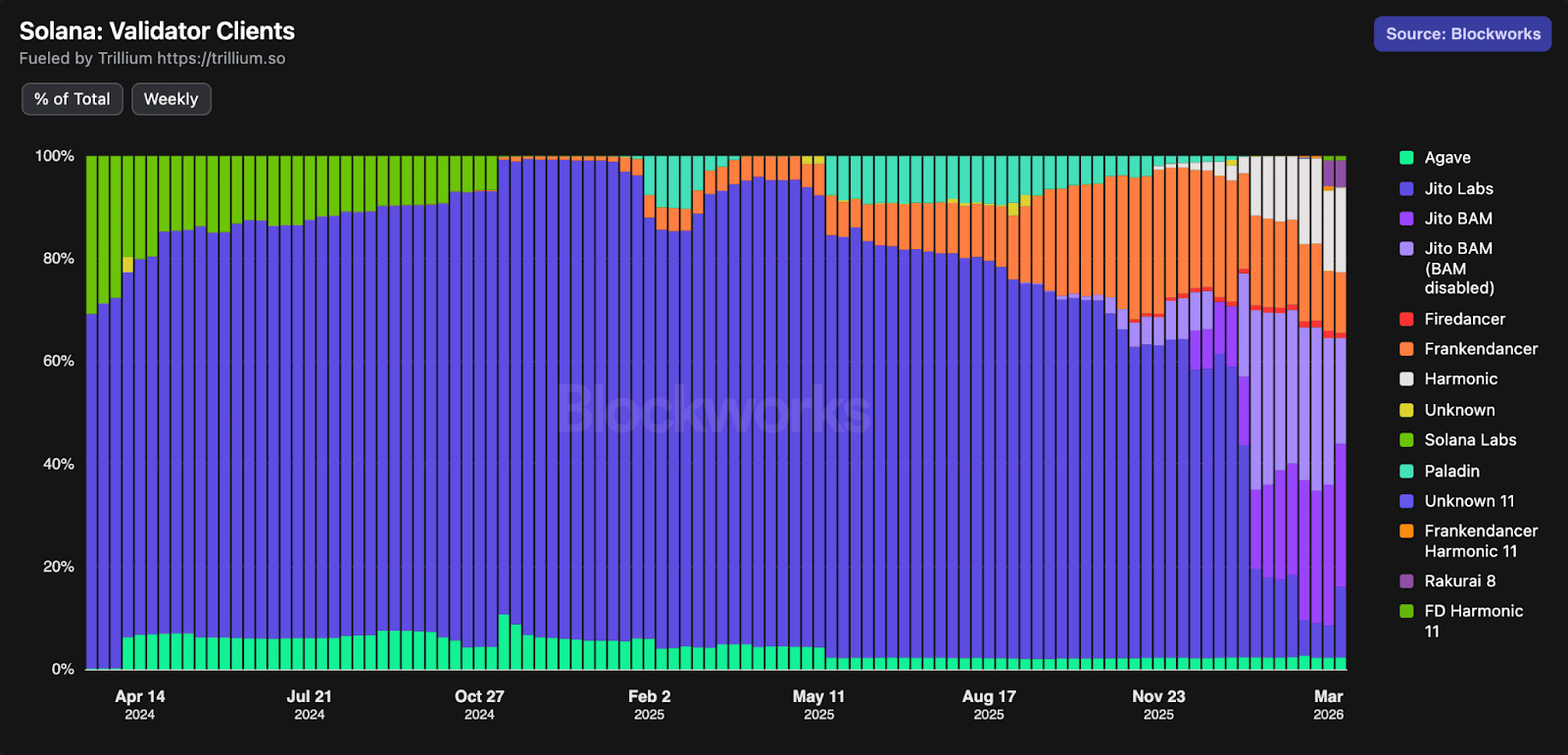
Prop AMMs solved spot because the oracle update and the reprice are essentially the same transaction; whichever pool lands it first wins routing, producing tighter quotes than CEXs on majors like SOL-USDC. It is more difficult for perps to use this same methodology. Makers and takers hold leveraged exposure requiring external oracles for liquidation neutrality, but the slot leader controls and introduces variability on when that update lands and in what order.
Beyond an in-protocol solution, there are developments in progress. Jito-BAM targets base ordering improvements (fees/CU then FIFO), but the real unlock may be Jito’s plugin framework, letting venues request priority for oracle updates and liquidation transactions.
— Sam

Jito interviewed three prop AMMs (ZeroFi, Ergonia, AlphaQ) and analyzed maker transactions across eight major firms to document why Solana’s execution layer still holds back onchain price discovery. Prop AMMs drive the majority of Solana spot DEX volume with SOL-USD spreads competitive against CEXs, but the validator scheduler rotating every 1.6 seconds means execution quality is non-deterministic.
Each validator client orders transactions differently; oracle update landing rates have measurably declined, forcing wider spreads. Jito frames BAM as the coordination layer fix, giving applications deterministic control over transaction execution across validators.

Ika introduces 2PC-MPC, a protocol where the user is always one of two signing parties, meaning the validator set cannot move assets without user participation. The network scales to hundreds of signer nodes with sub-second latency and 10,000 signatures per second by parallelizing cryptographic tasks across broadcast channels rather than pairwise rounds.
The piece contrasts Ika against existing custody providers (Fireblocks, Privy, Turnkey) and bridge protocols (Wormhole's 19 Guardians, LayerZero's 2-of-2 model), arguing all concentrate trust at the signing layer. Ika’s dWallet primitive lets smart contracts sign natively on any ECDSA or EdDSA chain without wrapped tokens or locked collateral pools.