- 0xResearch
- Posts
- Kraken cracks the Fed
Kraken cracks the Fed
While MetaDAO’s model gets a stress test


Nick Carpinito & Luke Leasure
March 05, 2026

Strength and breadth return to crypto and risk assets as Tuesday traded green across the board.
Progress seems to be accelerating on the regulatory front with Kraken’s approval for a “skinny” master account with the Federal Reserve, giving it direct access to the central bank’s payment rails.
Meanwhile, the MetaDAO project Ranger Finance is trading a proposal to liquidate its treasury and return capital to tokenholders, building a case study on the efficacy of this ICO model for early-stage capital formation. Enjoy!

Strength and breadth were notable across the board during Tuesday’s trading, with every index we track registering positive gains. At the top of the scoreboard are revenue leaders (+7.3%), L1s (+6.9%) and BTC (+6.4%). Notably, the rally is being led by BTC and majors across L1s and applications, not the long tail.

Zooming out to the monthly, we can see that crypto equities are the only index aside from gold showing positive returns, up 11%, reinforcing the theme of structural alpha in assets with enforceable claims on cash flows over those that do not.

Within crypto equities, CRCL leads the way, up 86% over the past month. The strength is followed by other names like BLSH (+31%), GEMI (+16%) and COIN (+14%).
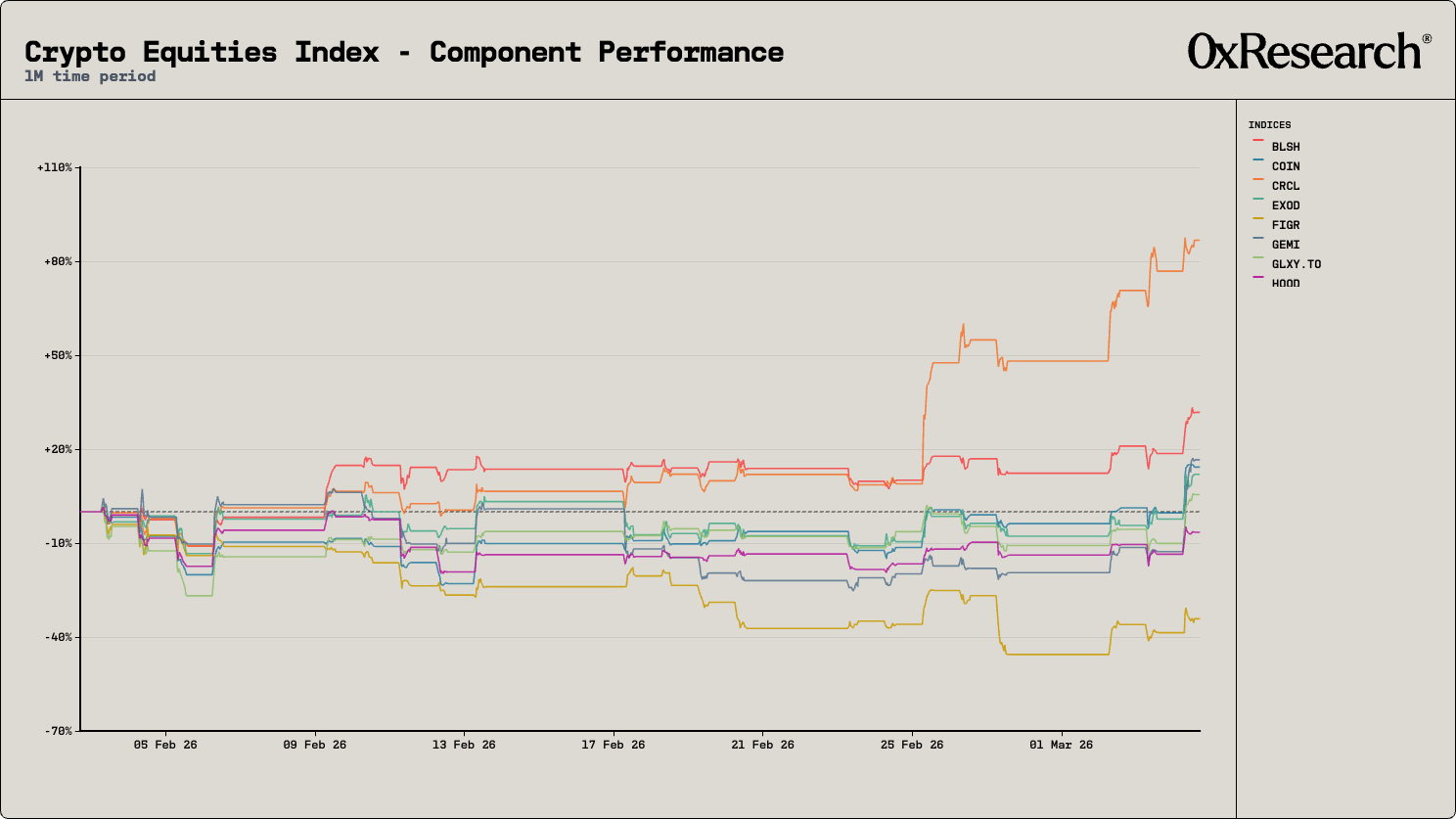
CRCL’s strength comes as a surprise to the street on the back of its recent earnings. While the BTC bear market of 2022 saw the total stablecoin supply contract by 31% (with the USDC supply falling 50%), this time such a contraction has not been the case. Instead, the total stablecoin supply has remained remarkably sticky and resilient, hovering just above $300 billion. The relative strength is testament to the product-market fit of this instrument, unphased by the past 51% drawdown in BTC.

While crypto-natives may be despondent from a stretch of poor price action, momentum only builds on the regulatory front. On Tuesday, Kraken Financial received approval for a Federal Reserve master account, marking the first time a crypto-native institution has secured direct access to the Fed’s core payment rails.
While the “skinny” account comes with restrictions — such as no interest on reserves and no access to the discount window — it nonetheless eliminates reliance on correspondent intermediary banks, providing a more durable and regulated foundation for custody, payments, and institutional cash management tied to its exchange. The decision signals a notable shift in the Fed’s posture toward regulated crypto institutions after years of resistance and legal battles.
— Luke
The MetaDAO accountability test
MetaDAO is currently undergoing a defining stress test as the community weighs a proposal to liquidate Ranger Finance.
The proposal, filed by RNGR tokenholders, cites material misrepresentations regarding volume and revenue, specifically the presentation of aggressive, uncontextualized projections as realized performance during the ICO process. The discrepancy — $5B in claimed volume and $2M in claimed revenue versus $2B and ~$500K in actuals — serves as a stark data point on the risks inherent in “points-first” distribution models where organic usage fails to materialize.
For Ranger, this is a particularly sharp fall from grace, as it previously stood as a cornerstone of the MetaDAO platform. With a target of $6M and $86M committed, of which $8M was retained, Ranger was marketed as a flagship project, attracting ~9K investors to its ICO. However, the current reality — it’s trading at a −8.9% ROI relative to the ICO price — highlights the fragility of these launches.
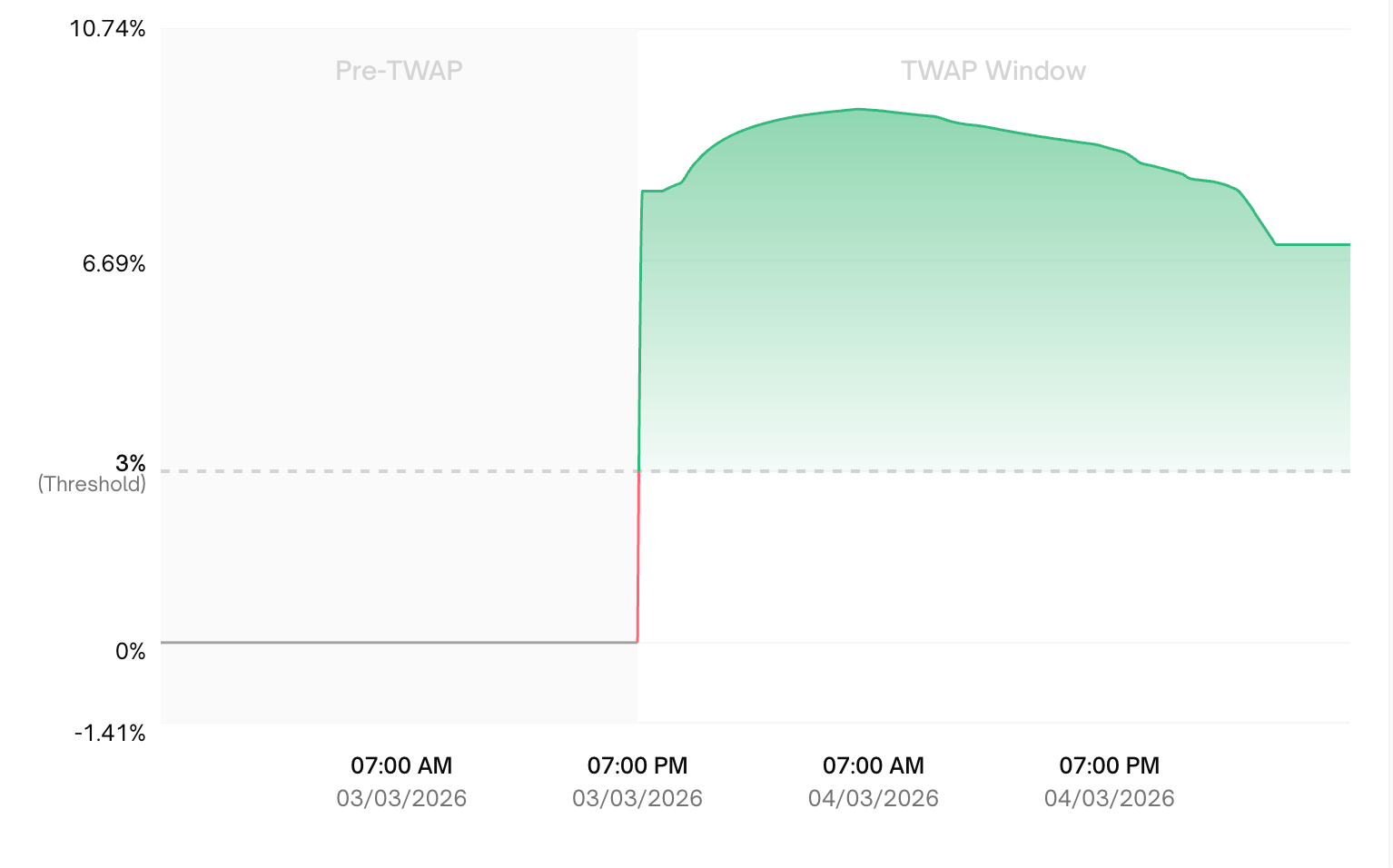
The prediction market for this proposal reflects significant conviction, indicating that decentralized decision-making is functioning efficiently. With voting underway, the market is signaling a strong “Yes” to liquidation, maintaining a ~7% spread, well above the 3% threshold required. Data indicates 6.7% of trading volume is aligned with the “Pass” outcome, validating the utility of futarchy as a governance tool for capital allocation. The Ranger team has notably signaled compliance with the process, standing down on their own planned buyback proposal to allow the liquidation vote to run its course.

For MetaDAO, the fallout is double-edged. While the proposal validates the platform’s utility as a governance tool for capital allocation, its 30-day trailing P/S ratio peaked at an anomalous 144.5x in early January 2026, driven by a transient dislocation between market capitalization and revenue. Since that peak, multiples have compressed sharply as revenue re-accelerated and market capitalization stabilized. Currently, the P/S ratio has normalized to ~18.2x, aligning closely with the historical range observed throughout late 2025.
If successful, this creates a precedent where onchain governance enforces capital repatriation when narrative-driven growth fails to convert into sustainable revenue. By allowing price discovery to dictate the fate of a misaligned treasury, MetaDAO provides an essential signal that legacy governance structures fail to capture. The recent launch of Futardio, a permissionless version of this futarchy framework, suggests the mechanism is maturing toward a scalable, standard-setting layer for capital formation that could perhaps replace legacy token agreements.
— Nick


Meta is shifting from the failed 2019 Libra model toward a USD-backed stablecoin strategy designed to optimize its $220 billion advertising engine. Unlike the previous attempt, this initiative comes as current regulatory support, public perception, and a focus on commerce over sovereign currency, create a viable path for adoption.
By embedding stablecoins directly into ad-checkout flows, Meta can collapse the conversion funnel while establishing a perfect, closed-loop attribution system that bypasses traditional payment leakage. This integration leverages Meta’s existing massive scale, positioning the company to become a primary onramp for stablecoin adoption, effectively turning ad optimization into a catalyst for blockchain utility.

This article by @0xmattegoat analyzes whether weekend prices on Hyperliquid meaningfully predict how traditional markets reopen. Using data from a geopolitical news event and broader weekend samples, the author shows that Hyperliquid markets react within seconds to new information and often move before many other crypto-linked instruments.
Across 35 assets, weekend prices predicted the direction of the Monday opening gap with 100% accuracy in one sample and about 90% accuracy across nine weekends, with a median error of just 14 basis points.
The conclusion is that Hyperliquid weekend markets are highly informative, though the best signal appears a few hours before traditional markets reopen.
On this episode of Empire, Santi is joined by Pranav Kanade and Tushar Jain. The speakers argue crypto is near the end of a downturn, with sentiment washed-out but fundamentals stronger due to growing institutional adoption.
They believe the market is mispricing the stack: Applications and cash-flowing protocols capture much of the value but are undervalued relative to L1 blockchains, creating a potential “apps vs. L1s” trade. They also expect AI and stablecoins to accelerate crypto adoption, with long-term value accruing to platforms that control users or liquidity rather than base infrastructure.

DAS NYC's lineup is bringing the biggest names in finance to the stage.
Don't miss the institutional gathering of the year — this March 24−26.