- 0xResearch
- Posts
- Ceasefire rally lifts all boats
Ceasefire rally lifts all boats
Risk-on momentum and Lighter’s post-TGE roadmap


Boccaccio & Marc Arjoon
April 08, 2026

Hi all, happy Wednesday!
Monday’s session was a straightforward risk-on move, with crypto rallying hard across the board on ceasefire optimism.
Privacy coins led the way, but the breadth of the move was the real story: Nearly every sector posted strong gains, suggesting this was macro-driven rather than any rotation into specific themes. The uniformity makes it easy to read but harder to trade around, since broad repricing events tend to leave fewer dislocations behind.
Today we also cover Lighter’s first post-TGE quarterly investor call, where the team laid out Q1 numbers and a busy roadmap that spans US regulation, Ethereum composability, and a push into RWAs and options.

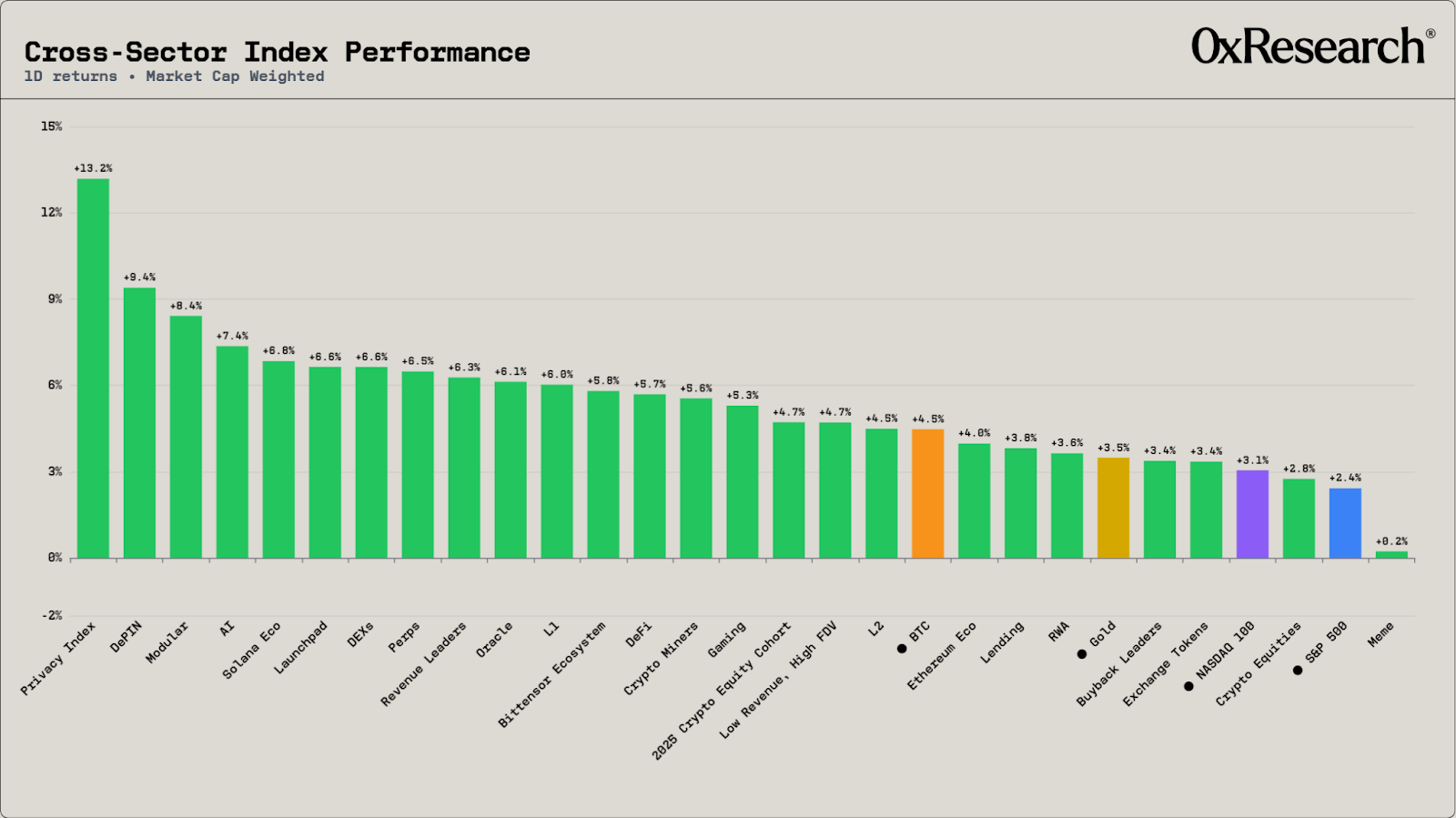
Over the last 24 hours, the broader crypto market staged a strong rally across virtually every sector, with the Privacy Index leading the charge at +13.2%, followed by DePIN (+9.4%). Gold (+3.5%) also gained but lagged BTC (4.5%).
Much of this momentum appears tied to optimism surrounding the ceasefire developments, which sparked a broad risk-on sentiment globally. Crypto, as one of the most sensitive barometers of risk appetite, responded aggressively. The scale and uniformity of gains across sectors suggest this wasn’t just technical buying, but a macro-driven repricing as uncertainty around the geopolitical backdrop temporarily eased.
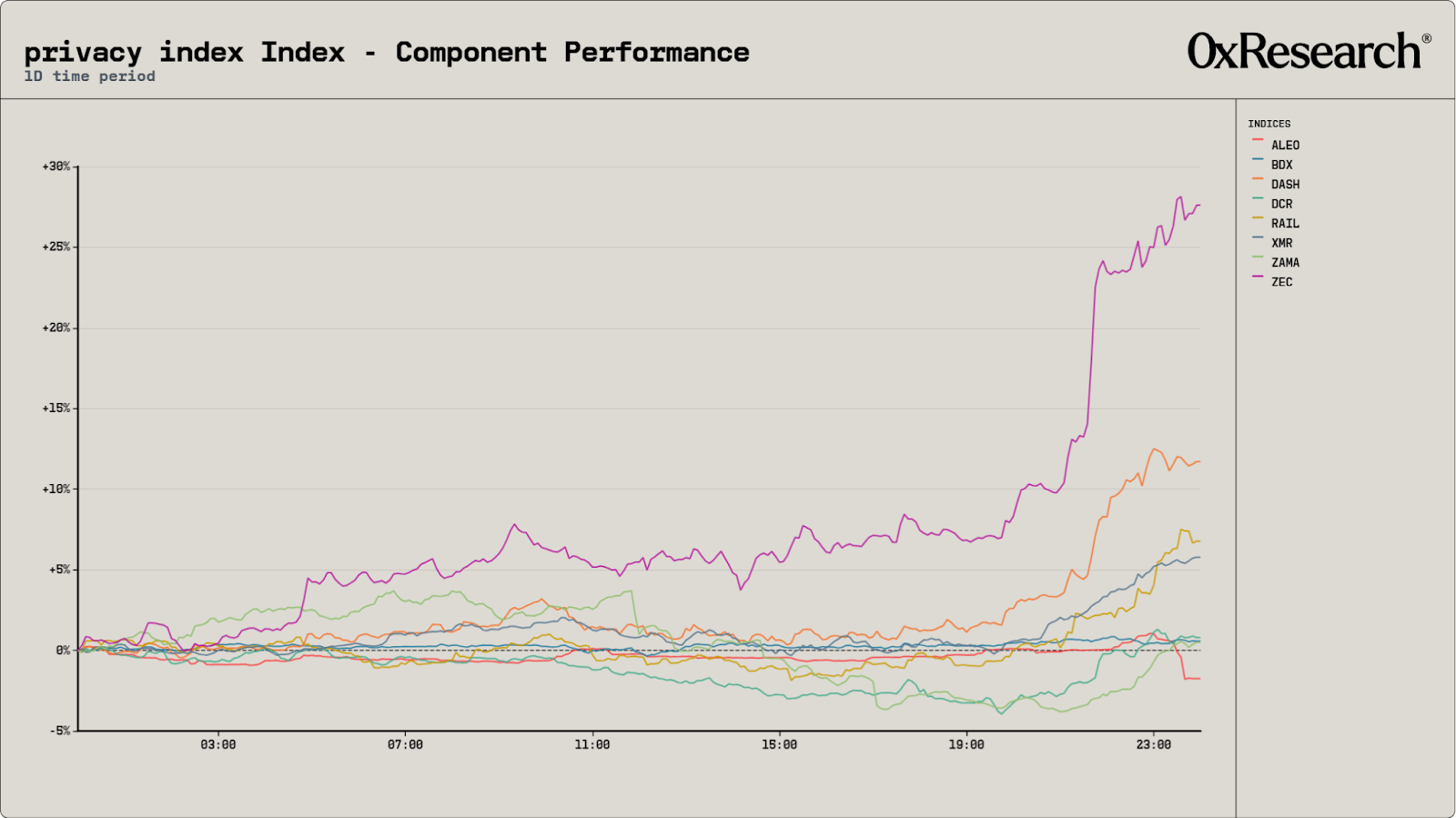
Within the Privacy Index, ZEC and DASH were the clear drivers of the sector’s +13.2% gain. ZEC was the standout, trading relatively flat for most of the session before spiking aggressively from ~+7% to nearly +28%, a near-vertical move that points directly to the ceasefire announcement as the catalyst. DASH, RAIL and XMR followed a similar but more-measured path as the rest of the index largely flatlined.
— Marc
Lighter’s quarterly investor call
1Lighter held its first quarterly investor call post-TGE. Q1 revenue was $14.4M on roughly $250B in volume, retention among real traders is solid, and the team is pushing into RWAs, US regulation, and Ethereum composability.
Q1 revenue came from maker/taker fees on premium tiers, with retail remaining fee-free. Volume was around a quarter trillion, down from pre-TGE levels, following points-driven activity drop-off. Average open interest stayed below $1B, which the team attributes partly to broad crypto risk-off sentiment and partly to a shift in participant interest toward RWAs over crypto-native assets. Daily active users averaged 25K. Retention among the cohort of genuine traders (excluding point farmers) has been strong by retail-product standards. The system processed 27.4B orders, roughly 1% of which converted to executed trades. LLP’s share of total TVL has declined significantly from its early days when it was nearly half, which the team frames as healthy, reflecting organic market maker growth.
The Lighter team discussed three strategic priorities going forward:
They want to achieve full Ethereum composability, where any Ethereum asset can be used as collateral on the platform. They see this as a way to tap into the large capital base already sitting in DeFi.
They want to secure a CFTC license for onchain-derivatives trading in the US, and founder and CEO Vlad Novakovski has joined the CFTC’s Innovation Advisory Committee as part of that effort.
They want to position Lighter as infrastructure for TradFi to move derivatives and spot trading onchain.
On the regulatory side, the team’s read is that the pending CLARITY Act mainly covers spot DeFi, not derivatives. So CFTC registration will still be required regardless, which they believe favors platforms that pursue it early. The licensing process has been started.
Universal cross margin is the biggest near-term engineering priority. The team changed sequencing to build the full system first rather than adding collateral types piecemeal. LLP will be the first new collateral asset (tokenized), followed by USDT, ETH and BTC spot. A correlation-aware margin model is targeted for Q3.
Lighter EVM, built with Axiom, is entering DevNet and targeting mainnet by late Q2 or early Q3. It lets any Ethereum application run on top of Lighter, sharing the sequencer with the ZK trading circuits. The team sees third-party prediction markets as a natural early use case.
On RWAs, the team acknowledged being too slow after an early start. They were first to list Korean equity perps but fumbled the quoting format for market makers.
Gold and silver liquidity is now described as top-tier, energy commodities are catching up, and Korean equities are being relaunched with fixes. Market-maker incentives focused on RWAs will be announced within weeks, funded through a mix of Season 3 rewards and potentially USDC.
Tokenized stocks on the spot side are expected to start in Q2. Options are being built in-house, starting with simpler structures like binary options and working toward a full order-book platform by the end of Q3.
The Telegram wallet partnership was announced the day of the call (custodial sub-accounts on Lighter), and the partner attribution program already has several live integrations.
Permissionless listings are on the 3−6 month horizon.

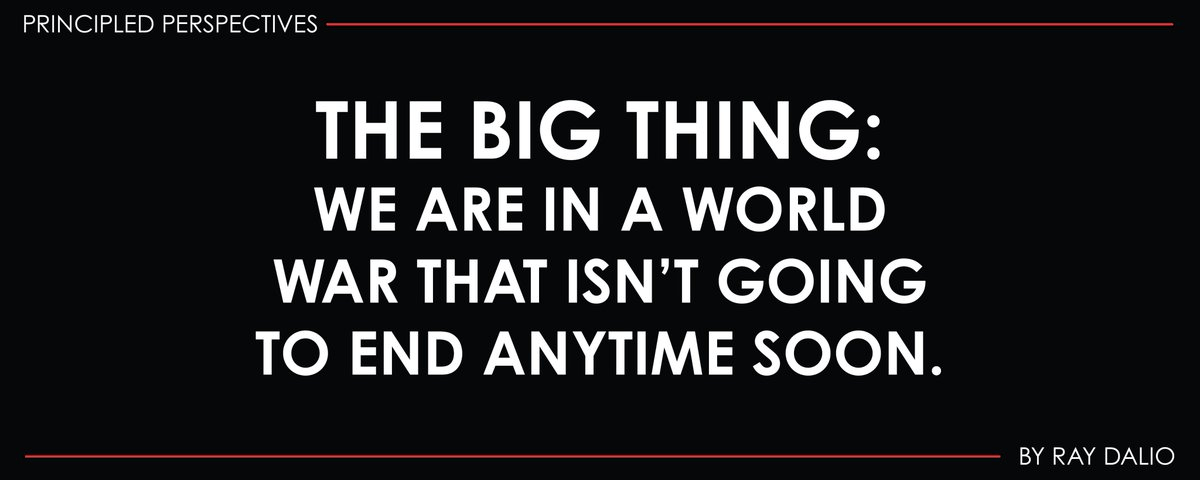
Ray Dalio posted a sweeping macro warning on X, arguing that markets are badly mispricing the current geopolitical environment. What most see as an isolated US-Israel-Iran conflict is, in his view, part of an early-stage world war that won’t end anytime soon. He draws parallels to the 1913−14 and 1938−39 periods, flagging US military overextension, fracturing alliances, and escalating multi-theater conflicts as classic precursors to major war. He puts the odds of at least one significant new military conflict within five years at greater than 50%, with a US-China confrontation over Taiwan as the most consequential risk, peaking around 2028.

OAK Research published a launchpad benchmark arguing that the ICO model’s failure was never the concept itself, but the lack of structure around project selection. After surveying five launchpad models, the piece highlights MetaDAO as the standout for replacing human curation entirely with prediction markets, where participants bet capital on whether a project creates or destroys value before a sale can proceed. With nine sales, $27M raised, and an ATH ROI of 6.49x since 2025, early results are strong, though the model depends heavily on sufficient liquidity to produce reliable signals.
Introducing Blockworks Investor Relations, an IR platform built for onchain businesses.
The latest Blockworks offering brings together analytics, a branded investor relations site, and integrated advisory support into a single platform. The result is a more efficient way to share your story, build trust with investors, and engage a global audience from day one.
Check out our cofounder Michael Ippolito's keynote at DAS NYC launching the new IR platform.