- 0xResearch
- Posts
- Bitcoin's New Balance Sheet
Bitcoin's New Balance Sheet
Who's really absorbing BTC's float?


Boccaccio & Marc-Thomas Arjoon
April 22, 2026

Hi all, happy Wednesday!
Global markets slipped as the Middle East ceasefire neared expiration and Iran's navy reportedly seized commercial vessels in the Strait of Hormuz, sending Brent crude back above $100. Equities sold off on both sides of the Atlantic, gold gave back some of its April gains, and the dollar continued to slide as traders looked past the war toward Fed cuts. Bitcoin, meanwhile, quietly outperformed, with meme tokens leading crypto sectors while equity-linked names lagged.
Today, we also dig into the shifting composition of BTC's institutional buyer base, where Strategy's latest 34,164 BTC purchase and a wave of new ETF filings are reshaping who absorbs supply and at what cost to common shareholders.

Global stocks slipped on Tuesday as the Middle East conflict continued to dominate sentiment ahead of the expected expiration of the two-week ceasefire. The S&P 500 fell 0.36% and the NASDAQ 100 dipped 0.13%, pulling back from last week's all-time highs. Losses were steeper in Europe, where the Stoxx 600 dropped 0.9% and London's FTSE 100 closed 1.1% lower. President Trump said the US would secure a "great deal" from hoped-for talks, but Pakistan indicated it had not received a formal response from Iran on attendance.
Tensions escalated sharply after Iran's navy claimed to have seized two commercial container ships in the Strait of Hormuz and escorted them into its territorial waters, though this could not be independently verified. UK maritime authorities reported that the vessels were fired upon, and Iranian media reported a third ship was also targeted. Brent crude, which had already climbed nearly 3% to above $98 on Tuesday, pushed back above $100 following the ship seizures. The European Commission warned that the energy shock could rival the 1973 and 2022 crises combined, with Europe having already spent an additional EUR 24B on fossil fuel imports since the war began.
Trump extended the ceasefire until talks conclude but refused to lift the US naval blockade of Iranian shipping.
Gold fell 1.84%, giving back some of its April recovery, while silver dropped 4%. Government bonds weakened, with 10-year Treasury yields rising 5 bps to 4.30% and UK gilt yields also climbing 5 bps to 4.89%. The dollar lost 0.3% against the pound and 0.4% against the euro, continuing to give back its war-era gains as traders shift focus toward possible Fed rate cuts.
Bitcoin edged up 0.61%, outperforming traditional risk assets for the day. Within crypto, meme tokens surged 19.7% to lead all sectors by a wide margin, followed by Privacy Index (+6.2%) and Ethereum Eco (+1.3%). The rest of the market was mixed to negative: Perps fell 2.2%, Crypto Miners dropped 4.5%, Crypto Equities lost 4.9%, and the 2025 Crypto Equity Cohort declined 6.2%. The pattern of speculative sectors outperforming while equity-linked crypto names lag persisted.
BTC’s Institutional Buyers
Strategy purchased 34,164 BTC last week, one of the three largest single acquisitions in the company's history, financed almost entirely through STRC preferred equity issuance rather than common stock ATM dilution.

This purchase saw BTC/share accretion move to 9.5% YTD with minimal equity dilution to common holders. The funding mechanism shift matters more than the headline number. MSTR shareholders are effectively getting leveraged BTC exposure without proportional dilution, while STRC holders absorb that leverage in exchange for a preferred wrapper. Strategy now holds ~815,000 BTC, marginally ahead of BlackRock's 802,823. The ETF complex added ~27,000 BTC over the past week and is running at roughly 1,800 BTC/day since inception.
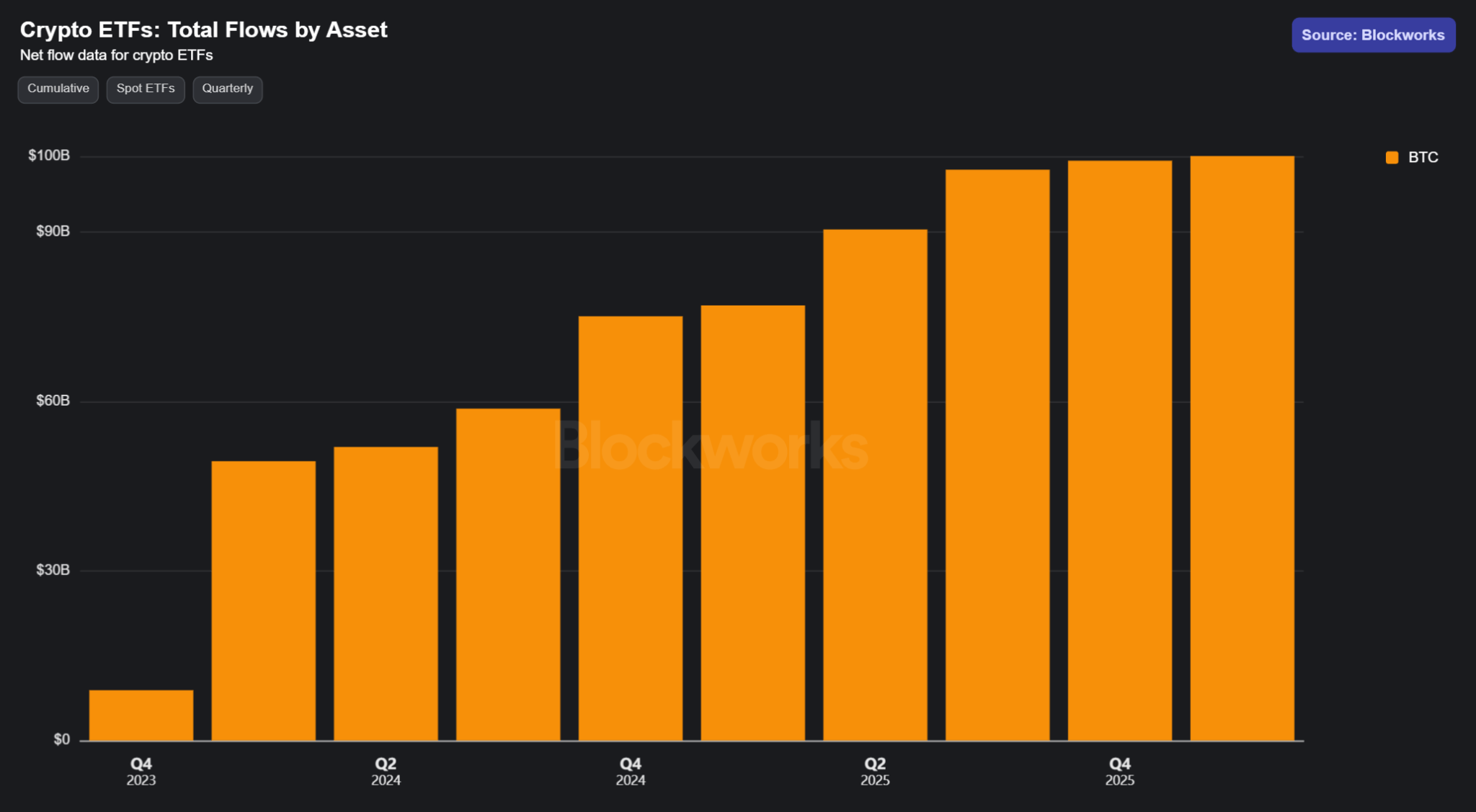
With Strategy adding ~1,100 BTC/day, these two buyers are pulling ~2,900 BTC/day against 450 mined. STRC now has net proceeds of $8.25 billion and has purchased roughly 98,843 BTC.

The long-term holder cohort appears to have largely exhausted its distribution appetite per onchain data, which tightens the available float considerably. However, short-term holders realized price still sits at $80,000, which has proven to be another level of resistance.

Keep in mind that large allocators continue to enter. Luxembourg's Intergenerational Fund disclosed a 1% BTC ETF allocation this week. Goldman Sachs and Morgan Stanley both filed for variations of BTC ETFs. Schwab began offering direct BTC exposure to its ~$11T AUM client base, undercutting Coinbase and Gemini on spread. The longer-term buyer composition is shifting structurally, not just at the margin.
— Marc


Tempo is officially bringing stablecoin payment flows into production for major partners like DoorDash, Stripe, and Coastal Bank, utilizing their blockchain purpose-built for enterprise scale. Unlike general-purpose networks, Tempo claims to offer sub-second finality, predictable fees, and private "Zones" to handle complex global payouts and treasury operations. To accelerate broader adoption, Tempo also launched Stablecoin Advisory, a hands-on consultancy designed to help financial institutions and Fortune 500s navigate the technical and compliance hurdles of integrating stablecoins into their existing payment stacks.

SIX and Chainlink have partnered to bring real-time data for Swiss and Spanish equities (representing over €2 trillion in market value) onchain for the first time. Utilizing Chainlink’s DataLink service, this integration allows more than 2,600 applications across 75+ public and private blockchains to programmatically access high-quality market data. By bridging traditional exchange data with smart contract environments, the collaboration unlocks new possibilities for tokenized indices, structured products, and compliant DeFi applications, further solidifying the infrastructure needed for the next generation of digital financial markets.
Introducing Blockworks Investor Relations, an IR platform built for onchain businesses.
The latest Blockworks offering brings together analytics, a branded investor relations site, and integrated advisory support into a single platform. The result is a more efficient way to share your story, build trust with investors, and engage a global audience from day one.
Check out our cofounder Michael Ippolito's keynote at DAS NYC launching the new IR platform.