- 0xResearch
- Posts
- Bitcoin’s quantum deadline



GM all, and happy Thursday. Risk is back on the table as bitcoin moves back to range highs, while SPY and QQQ each closed Wednesday at a new all-time high. With a decisive rally in equities, the ball is in crypto’s court to match this strength and set the trend back higher.
Below, we discuss the growing urgency around Bitcoin’s post-quantum transition and why the real constraint is not cryptography, but coordination.

Equity markets are rallying hard, putting in one of the strongest 10-day rallies in history and closing at record highs. With this backdrop, the VIX is crushed below 20, and oil has moved 25% off its highs, easing many of the concerns around inflation or demand destruction arising from this shock.
With this bullishness, bitcoin and crypto show tepid strength, with BTC trading near range highs since the February low. Crypto Equities and Crypto Miners are the largest gainers over the past week, up +20.3%, benefiting from renewed momentum across equities, crypto and public-market AI stocks. The top losers over the past week are crypto AI (−25%) and the Bittensor Ecosystem (−35%), still reeling from the departure of one of TAO’s most successful subnet projects, Covenant.
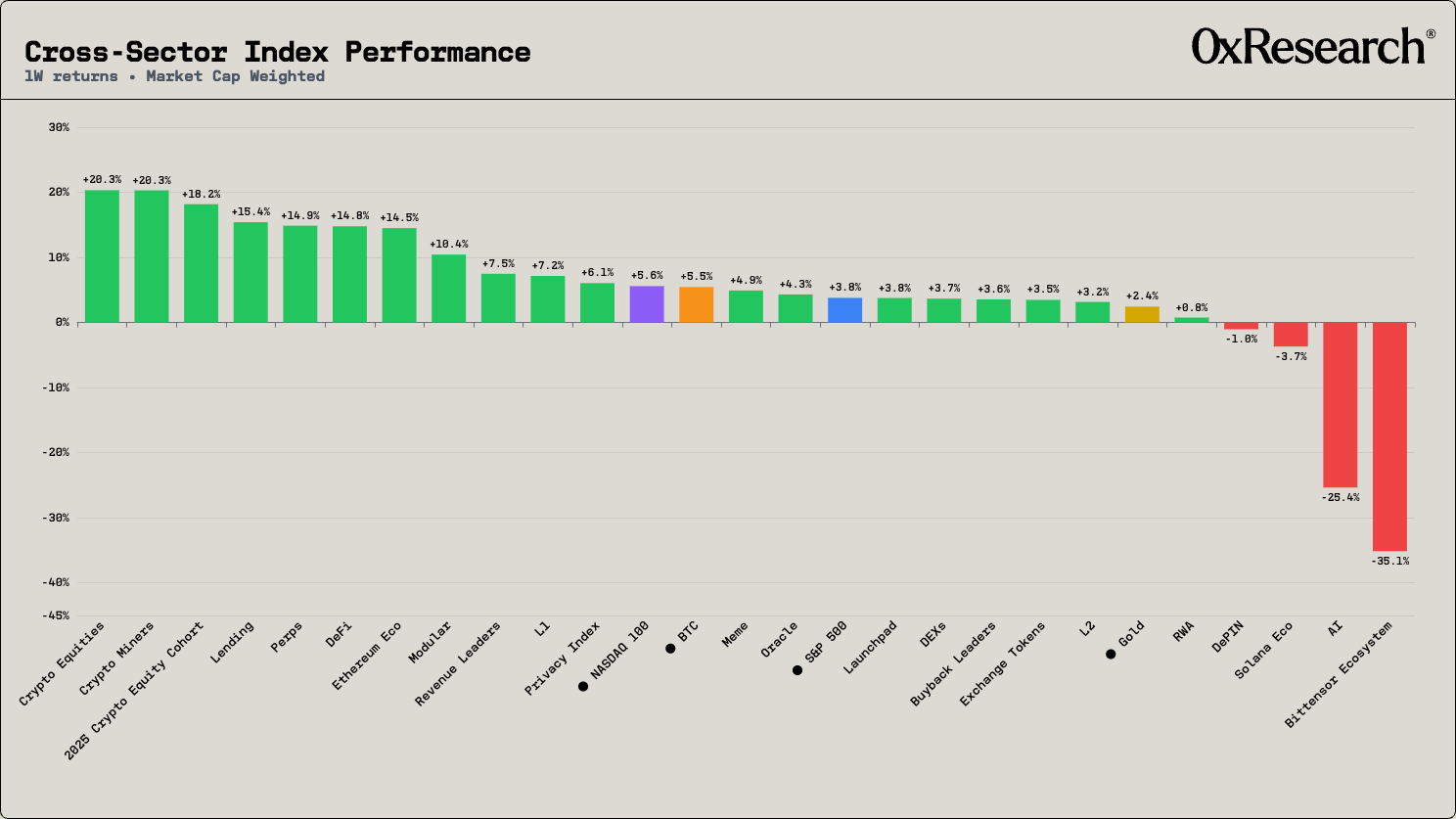
Behind Equities and Miners, Perps and Lending come in as the third and fourth strongest sectors over the past week, up +18% and +15% respectively. Lending, borrowing and leverage are some of the killer products in DeFI, and these two sectors each stand to benefit if bullish momentum grows. While the Lending sector shows strength in token price action, this has yet to be mirrored in the fundamentals, as deposits, loans and yields remain near their recent lows. The bear of Q1 brought historically low yields to stablecoin lending, reaching as low as 2.05%, a steep discount to T-bills.

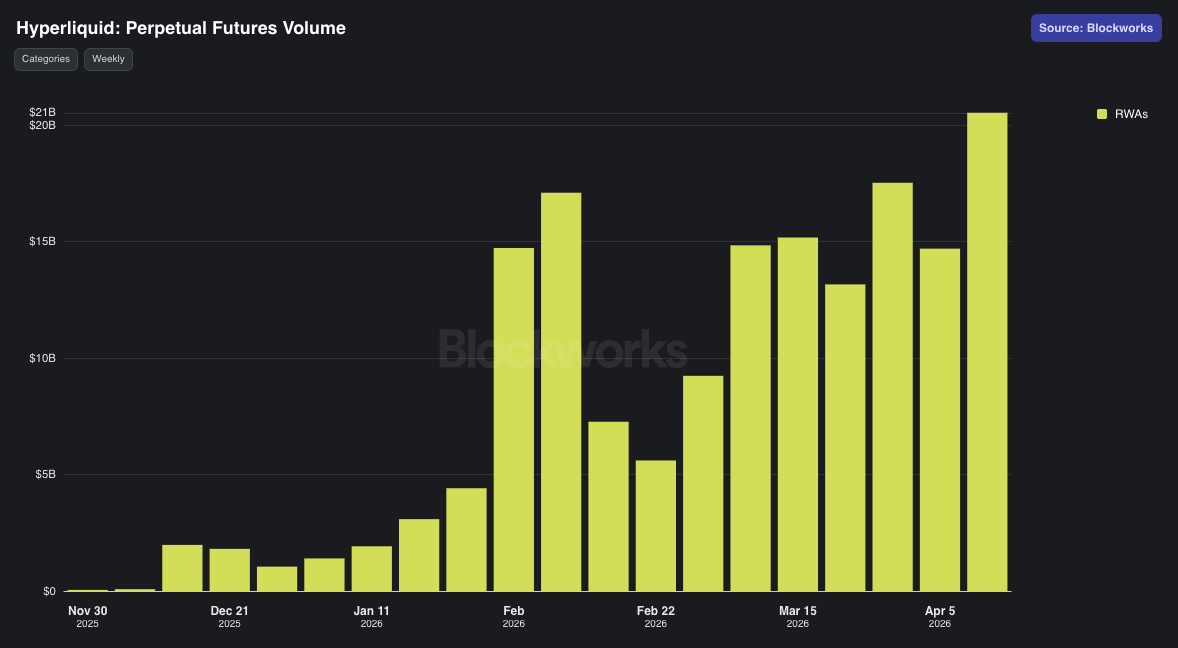
In contrast to lending yields, Hyperliquid’s RWA perps traded a new all-time high in volume last week of over $20B, reminding us that there’s always a bull market somewhere.
— Luke
Bitcoin’s quantum migration clock
BIP-361 was published yesterday. It aims to introduce a coordinated, multi-phase migration away from ECDSA/Schnorr toward post-quantum signatures, formalizing a deterministic path for Bitcoin’s cryptographic upgrade. The proposal reframes quantum risk from a probabilistic tail event into a scheduled protocol transition, with escalating enforcement over time.

The core mechanism is a three-phase rollout. Phase A restricts new UTXOs by disallowing sends to quantum-vulnerable scripts, forcing incremental adoption of PQ address types. Phase B enforces a hard sunset, invalidating all legacy signature spends at a pre-announced block height approximately five years post-activation. Phase C, which is still undefined, proposes a recovery path for stranded funds via zero-knowledge proofs of cryptographic seed ownership.
This design is structurally distinct from prior Bitcoin upgrades. Rather than preserving backward compatibility indefinitely, BIP-361 introduces an explicit expiry on legacy cryptography. The result is a credible coordination mechanism where upgrade inertia is addressed through a fixed deadline that creates asymmetric downside for non-participants.
The economic implications are significant. Over 34% of BTC supply has already-exposed public keys onchain, making it theoretically vulnerable to quantum extraction. By preemptively invalidating these spends, the proposal converts potential attacker profit into protocol-enforced supply reduction. Lost coins become permanently unspendable, tightening circulating supply while removing incentives for adversarial accumulation.

Crucially, the proposal internalizes quantum security as a private cost. Wallets, custodians and institutions must upgrade or risk asset inaccessibility, aligning incentives without relying on collective action alone. This mirrors how Ethereum handled state rent discussions and how markets have historically priced in protocol-level changes when timelines are credible.
The broader takeaway is that Bitcoin may be entering a new governance regime. If BIP-361 gains traction, it sets a precedent for time-bound cryptographic assumptions, replacing Bitcoin’s historically conservative upgrade cadence with a more proactive, adversarial model.
— Nick


Matt Hougan published an article arguing that bitcoin’s recent outperformance during the Iran conflict reflects a structural repricing rather than a breakdown of its risk-asset behavior. He frames BTC as a dual bet, combining its established store-of-value narrative with an underappreciated “currency option” that gains value as geopolitical fragmentation increases.
The article highlights how the weaponization of financial rails, beginning with Russia’s removal from SWIFT in 2022, has accelerated the search for neutral settlement layers. Hougan points to Iran’s reported use of BTC for oil transit fees as an early example of state-level experimentation, suggesting that conflict zones may serve as initial adoption vectors. He concludes that bitcoin benefits directly from rising macro volatility and the increasing probability of non-sovereign settlement demand, implying its total addressable market extends beyond gold if it captures both store-of-value and transactional use cases.
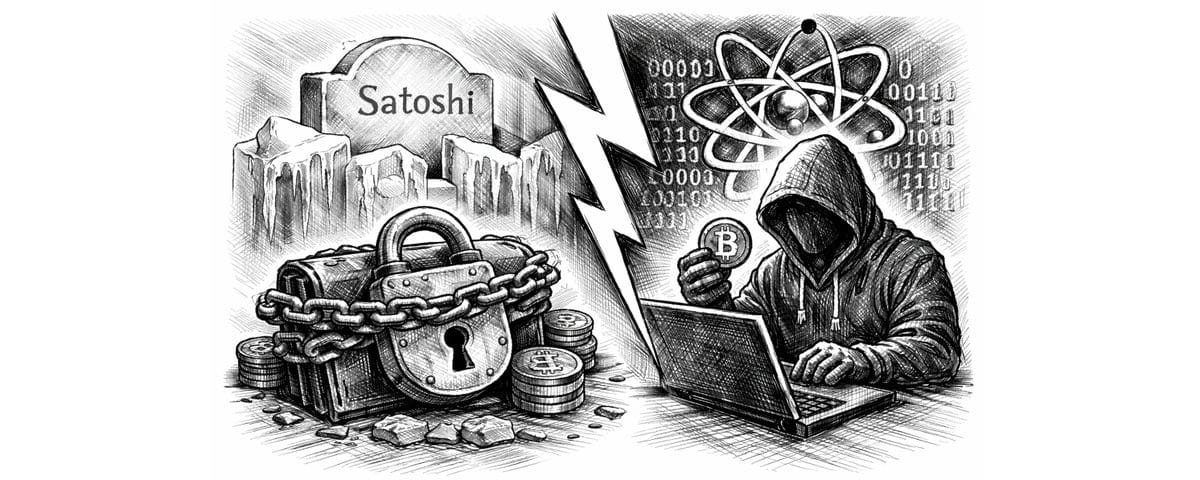
Ki Young Ju published an article outlining the core tradeoff embedded in any Bitcoin post-quantum upgrade: Securing the network may require freezing a significant portion of existing supply, including Satoshi’s ~1M BTC and millions more held in legacy address formats. Ju emphasizes that the primary constraint is not technical implementation but social coordination. Historical precedent from the block-size wars and SegWit2x suggests that BIP-361 will face significant ideological resistance, raising the likelihood of contentious forks.

Jump argues that on Solana, PropAMMs already outperform major centralized exchanges on highly traded pairs like SOL/USDC; they do this by delivering tighter all-in pricing for most users while also matching or exceeding their volume in the sample they analyzed. PropAMMs are presented as a new kind of onchain market maker that combines offchain pricing with onchain execution, aiming to break the old tradeoff where decentralized trading offered openness but worse execution than centralized exchanges.
The article’s broader claim is that permissionless markets can now become superior venues for trading because competition is more open, execution logic is embedded directly onchain, and upcoming Solana upgrades could further reduce latency and MEV-related inefficiencies.
Introducing Blockworks Investor Relations, an IR platform built for onchain businesses.
The latest Blockworks offering brings together analytics, a branded investor relations site, and integrated advisory support into a single platform. The result is a more efficient way to share your story, build trust with investors, and engage a global audience from day one.
Check out our cofounder Michael Ippolito's keynote at DAS NYC launching the new IR platform.