- 0xResearch
- Posts
- Beta takes over



Hey all, happy Tuesday! Fitting for St. Patrick's Day, markets stayed green to start the week, with crypto continuing to show relative strength versus equities. BTC once again outpaced the major stock benchmarks at the March 16 close, extending the recent pattern of crypto holding up better than the broader risk complex.
Today, we also take a closer look at Derive, whose DRV token has surged roughly 108% over the past week, outperforming the broader market. We examine the protocol’s top-line metrics to see whether fundamentals are keeping pace with price action, and what recent growth in options activity could signal as crypto market structure continues to mature.

Memes lead, AI lags
BTC closed March 16 up 2.6%, ahead of QQQ at 1.6%, SPY at 1.4% and gold at −0.1%, but the more interesting move happened further out the curve. Once the tape turned green, traders did not stop at BTC. They pushed hard into high-beta alt segments — memes, privacy and perps all posted gains that dwarfed the move in the majors.

Cross-sector, the Meme Top 10 led the board at 11.7%, followed by Privacy at 9.5% and Perps at 9.3%. Breadth was strong, with 23 of 24 BWR sector indices closing positive, but the composition mattered. AI Top 10 was the only red sector at −1.0%, which is a sharp reversal from the recent pattern where AI carried much of the crypto beta on higher timeframes.
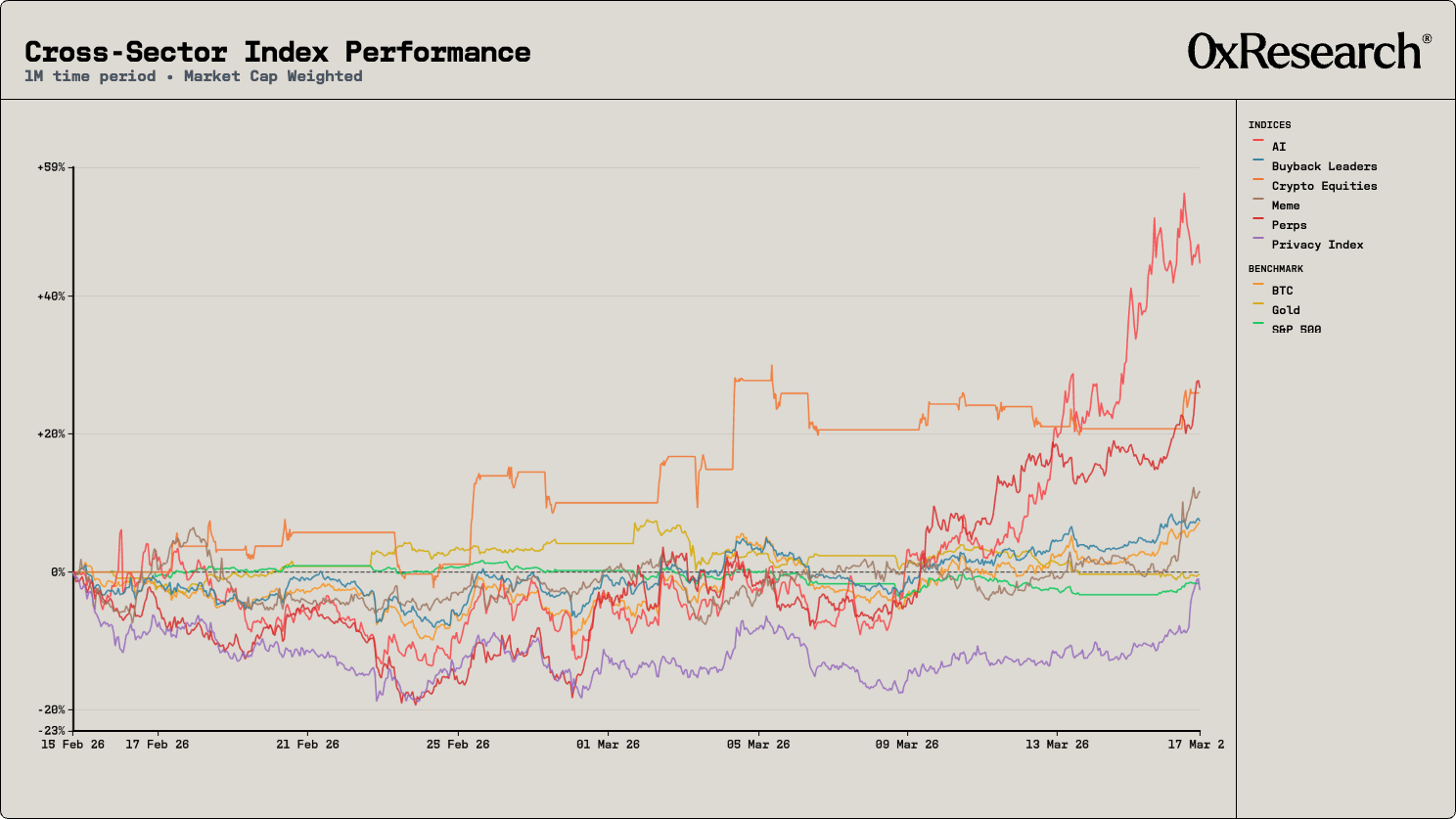
The laggards tell the same story. Crypto Equities finished only 0.4%, while Buyback Leaders and Exchange Tokens managed just 0.6%. That is weak participation from the more institutional or cash-flow-linked sleeves of crypto, especially in a session where top alt baskets were up 8% to 12%. The market clearly rewarded faster-money themes over steadier balance-sheet or revenue narratives.
That leaves the March 16 close looking less like a broad quality bid and more like a speculative rotation. If this rally has real legs, the next session should show whether leadership can expand beyond memes and perps into stronger fundamental cohorts. If not, this starts to look like a sharp but narrow burst of risk appetite rather than the start of a cleaner market-wide reset.
— Daniel
Inside Derive’s volume surge
Derive (DRV) has been one of the strongest-performing tokens over the past week, rallying roughly 108% in an otherwise range-bound market. That makes today a good time to revisit the protocol’s top-line metrics and ask whether fundamentals are moving in step with price action.
Historically, onchain options venues have gained far less traction than perp exchanges. Most retail users want directional exposure, for which perps are simply a better product. Options, by contrast, are better suited to non-linear strategies such as hedging, yield generation, and structured positioning. If crypto market structure continues to mature beyond predominantly retail speculation, that shift should increasingly favor options and, by extension, Derive.
Derive’s options notional volume is at an all-time high, with March 2026 already exceeding $900M and on pace to surpass $1B comfortably, with roughly half the month remaining. Perp volume on the platform is also at its highest level in more than a year, with only the incentive-driven spike in December 2024 and January 2025 ahead of DRV’s token launch exceeding current monthly levels.

Options remain the protocol’s primary growth driver. They reached a record 80% share of total volume in October 2025, coinciding with the 10/10 crash, and have accounted for more than 60% of total volume in recent months.
Dividing volume by trade count also reveals a clear difference in user profile: In the six months prior to March 2026, the average options trade size was about $30K, versus roughly $3.5K for perps. That gap suggests options activity is skewing toward more sophisticated traders, while perps remain more aligned with retail flow.

At the start of Q4 2025, the Derive team shifted its focus toward improving RFQ liquidity for large trades, and the data suggests that effort is working. RFQ options volume broke out in December 2025, surpassing orderbook volume for the first time. RFQ volume has already exceeded $700M this month, as seen in the chart below.

Derive is also broadening the platform beyond its legacy BTC and ETH base. HYPE is the clearest example: In roughly six months, it has grown from zero to more than $250M in monthly volume, mostly in perps but with meaningful options activity as well. On March 15, 2026, SOL options came out of stealth mode, adding a fourth asset with meaningful liquidity and trading demand.

Nick Forster, Derive’s founder, has said the protocol’s ambition is not simply to become an “onchain Deribit,” but to build infrastructure for creating any payoff on any asset, 24/7. He also recently released an article highlighting that Derive has no dual equity-token structure and no competing incentive structures, with 25% of net fees going to DRV buybacks.
As crypto market structure matures, Derive looks better-positioned than at any point in its history. Its improving RFQ liquidity, broader asset coverage, onboarding of new market makers, and off-exchange custody all point toward a platform increasingly built for larger and more sophisticated participants.
That said, the key question is whether recent momentum proves durable, making it crucial to monitor volumes and revenues over the next few months to see whether fundamentals continue to build alongside price.
— Carlos


Mike Ippolito from Blockworks published a “crypto-native” IR playbook arguing that tokens underperform when teams don’t actively expand and educate their buyer universe. He frames good IR as a mix of distribution, narrative, and data: Target liquid funds with clear metrics and milestones for re-rating, target strategics with longer-cycle relationship selling, and stay consistently transparent so the market doesn’t fill in the blanks.
He emphasizes planning unlocks far in advance, reducing diligence friction with high-quality materials and context, and using onchain analytics to understand and upgrade the holder base.

Monk and Ryan Watkins from Syncracy argue the next step-function “crypto export” will be the perpetual swap, and that perps DEXs will be the biggest winners as perps expand into equities, commodities and beyond. They frame perps as the simplest vehicle for retail leverage, making them a cleaner alternative to options-for-speculation and a structurally superior replacement for opaque CFDs.
Hyperliquid is presented as the inflection point that made perps DEXs truly competitive by rebuilding the stack for trading (low latency, maker-friendly sequencing, deterministic fees, strong risk engines), with HIP-3 showing how perps can bring new markets onchain fast.
The core claim is that incumbents can’t easily replicate the full atomic margin + real-time settlement stack inside today’s legacy architecture, while DEXs compound via permissionless distribution and software-like operating leverage.

Carl Vogel from 6th Man Ventures published an article arguing that “agentic VC” isn’t about building AI trade desks, because venture is driven by trust and conviction, not arbitrage. Instead, agents should automate the table-stakes work (research, memos, diligence, portfolio ops) so humans can spend more time helping founders and making judgment calls. They predict a bifurcation in which “super angels” scale investing via automation while larger firms expand into “venture builder” platforms.
At 6th Man Ventures, he describes three tools the firm has built: an AI deal-eval system that generates fast, data-heavy memos; a Telegram to-do agent that tracks and auto-closes founder requests to improve responsiveness; and a liquid-monitoring agent that aggregates fundamentals, price, and news into on-demand reports and alerts.

DAS NYC's lineup is bringing the biggest names in finance to the stage.
Don't miss the institutional gathering of the year — this March 24−26.