- 0xResearch
- Posts
- Agents need a bank account
Agents need a bank account
Stripe and Paradigm’s payments chain goes live

Nick Carpinito
March 19, 2026

Happy Thursday!
The one-month index chart below is about as clean a picture of narrative concentration as you will see. In the Market Update, we cover current developments: The 2025 Crypto Equity Basket is up over 100%, AI tokens have continued their surge into second place, and nearly everything else is flat. The market is selectively risk-on, and the selection criterion looks a lot like “proximity to the AI trade.”
Tempo mainnet went live yesterday, and it sits squarely at the intersection of both themes. Incubated by Paradigm and Stripe, Tempo is a purpose-built payments infrastructure for programmatic machine-to-machine transactions — the settlement layer for a world where AI agents are paying for compute, data and services continuously rather than in discrete human-initiated steps. The launch included the Machine Payments Protocol, an open standard co-authored with Stripe; Visa, Lightspark and over 100 services were already integrated at launch. Today we break it down.
The one-month cross-sector index chart (below) tells a story of extreme concentration. The 2025 Crypto Equity Basket has been the runaway leader, up roughly 96% on the month, with AI tokens staging a late surge that pushed them to the second spot.
DeFi, DePIN, L1s, L2s, perps, lending and gaming are compressed into a narrow band, near-flat. The outperformance is almost entirely confined to equity-adjacent and AI-narrative tokens, while the broader crypto beta trade has gone largely unrewarded.

At the asset level, the tape reflects the same caution. BTC is sitting around $70K, down 3.9% on the day, and was unable to clear the $75K resistance level that has capped multiple rally attempts this month. ETH is down as well at $2.2K, performing marginally weaker on a relative basis. The Fear & Greed Index sits at 17, deep in fear territory, while price action has remained orderly rather than panicked, a divergence between sentiment and realized volatility that typically precedes a directional resolution. BTC dominance at 56.2% signals that altcoin rotation has not meaningfully materialized.
Capital has instead concentrated in a handful of high-conviction narratives rather than rotating broadly into the beta trade.

The macro overhang cleared, at least in terms of the known unknown. The Fed held rates steady at 3.50−3.75% for the second consecutive meeting, voting 11−1, with the dot plot signaling one cut still expected in 2026 and one in 2027. The growth outlook was nudged up slightly to 2.4% for 2026, but the inflation forecast was revised higher to 2.7%, core included, reflecting energy pressure from the US-Iran war backdrop. No policymakers indicated a preference to raise rates, which kept the reaction contained. Powell’s tone was measured, and the hold was priced in. The inflation revision is the detail worth watching, as it narrows the window for the projected cut and adds friction to the reflationary narrative that has been supporting risk assets at the margin.

— Nick
The agentic payments thesis got its clearest infrastructure statement yet yesterday. Tempo, incubated by Paradigm and Stripe, launched mainnet alongside the Machine Payments Protocol (MPP), an open standard for programmatic machine-to-machine payments. The team argues that as AI agents become capable of executing multi-step workflows across the internet, payments stop being limited to discrete, human-initiated events, and instead become continuous, high-frequency infrastructure requirements.

The core insight behind MPP is that the friction in agentic commerce is not settlement, but rather coordination. Every service that a developer-agent might invoke today has its own billing flow, authentication requirement and payment-method expectation. MPP standardizes the request, authorization and settlement layers so that any compatible service can be paid by any compatible agent without bespoke integration. The “sessions” primitive is the key mechanism: An agent sets aside funds upfront and opens a session. Payments then stream continuously against that reserve as the agent consumes resources, with thousands of microtransactions aggregated into a single settlement transaction.
The partner surface at launch is notable. Visa has extended MPP to support card-based payments; Stripe has extended it across cards, wallets and additional payment methods; and Lightspark has integrated it for Bitcoin Lightning payments. On the commerce side, the payments directory already lists more than 100 MPP-compatible services at launch, including Alchemy and Dune Analytics, with design partners spanning Anthropic, DoorDash, Mastercard, Nubank, OpenAI, Ramp, Revolut, Shopify, Standard Chartered and Visa.

The framing that Tempo explicitly rejects is the general-purpose L1. The pitch is predictable fees, dedicated payment lanes to prevent congestion during high-throughput payout runs, protocol-level memos for embedded finance, and compliance registries designed to mirror traditional financial controls.
That last point matters for the institutional use cases such as cross-border remittances, tokenized deposits, and global payouts, which require reconciliation primitives and auditability that general blockchains do not provide natively. The question is whether “purpose-built” actually means defensible, or whether a sufficiently performant general-purpose chain captures the workload anyway. Paradigm and Stripe’s fingerprints on the project suggest the bet is on the former.
— Nick

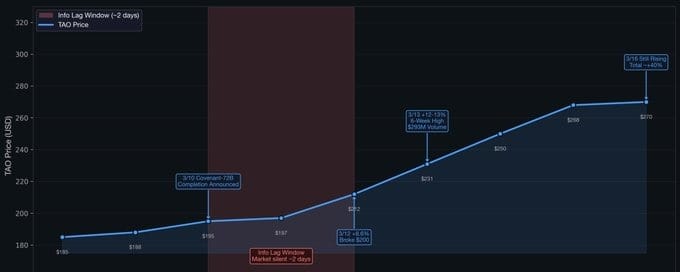
0xai published a report arguing that Bittensor’s subnet three, Templar, achieved a meaningful inflection point in decentralized AI training by completing Covenant-72B, a 72B-parameter model trained across more than 70 independent nodes with no central coordination.
The report contends that Covenant-72B outperforms Meta’s LLaMA-2-70B on MMLU (67.35% vs. 63.08%), GSM8K, and IFEval benchmarks, and that the remaining gap versus current SOTA models like Qwen2.5-72B reflects engineering headroom rather than a fundamental theoretical barrier.
The authors frame TAO’s muted two-day price response following the March 10 announcement as a cognitive arbitrage window created by the disconnect between crypto investors and AI researchers. They argue that the market is pricing Bittensor as an application-layer project despite its validation as foundational AI infrastructure.

Sonya Kim published a blog post arguing that stablecoin supply growth, expanding at a 149% CAGR since 2020 versus 30% for crypto market cap, is structurally decoupling from crypto collateral demand, creating a yield gap that only real-world asset borrowers can fill.
The post examines Morpho collateral-market data showing RWA-backed borrowers paying 4.4−5.7% versus 3.2−3.4% for crypto-backed positions. Kim attributes the 50−80% premium to looping demand anchored to global credit spreads, rather than to crypto sentiment.

A panel discussion on prediction markets at ETH Denver examined the structural role of decentralization in crypto-native financial applications, using Polymarket and Hyperliquid as primary case studies. The conversation explored why end users demonstrate consistent indifference to decentralization as a feature while the property remains operationally critical.
Dragonfly’s Haseeb Qureshi argues Polymarket’s global reach and Hyperliquid’s cross-border perps volume in markets like South Korea derive not from user preference but from the protocols’ resistance to licensing, geofencing and shutdown.
The panel also traced prediction markets’ presence in the 2013 Ethereum whitepaper to their illegal status in the US at the time, arguing that the current institutional legitimacy of the space, including the entry of firms like BlackRock, was built on a foundation of protocols operating outside regulatory frameworks before those frameworks existed.
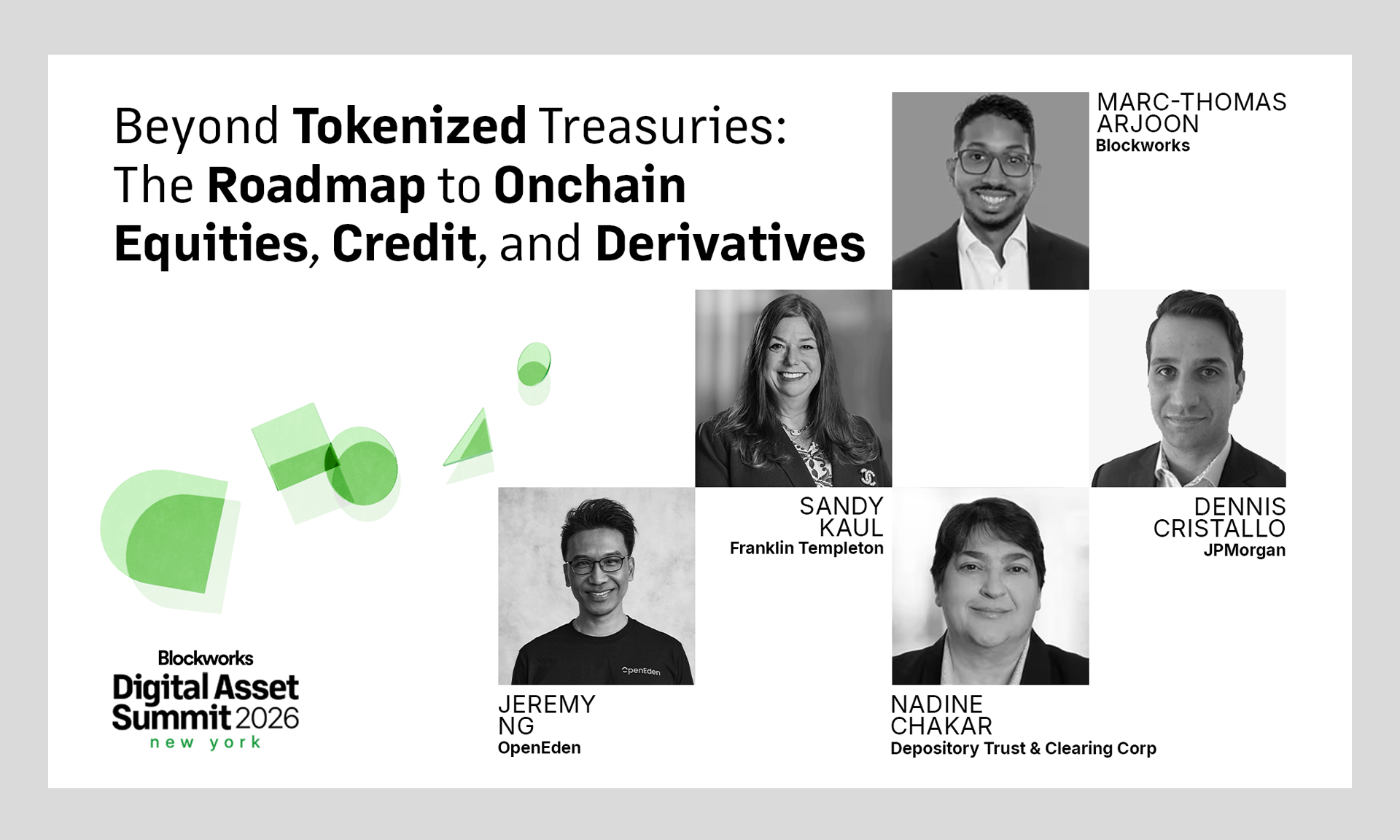
DAS NYC's lineup is bringing the biggest names in finance to the stage.
Don't miss the institutional gathering of the year — this March 24−26.